
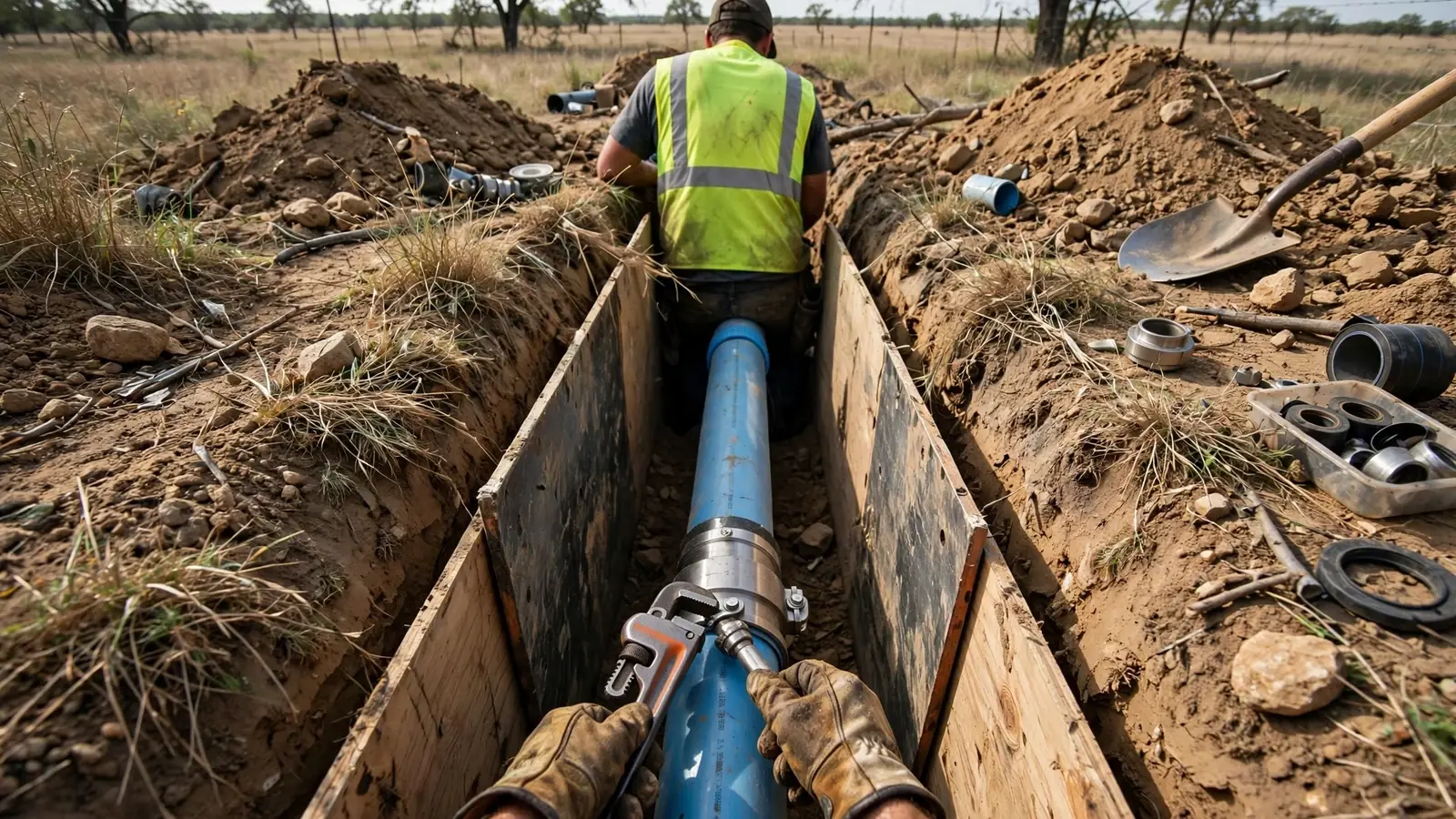
Where the line runs and who owns which part
The water service line starts at the meter, usually in a box near the curb, and runs underground to the main shutoff valve at your house. It may cross a lawn, a walkway or a driveway on the way. Depth, material and route differ from lot to lot, so the first step in any repair is learning where yours actually goes.
Union City buys its water from the City of Atlanta and maintains its own distribution system of about 112 miles of water line. Its leak guidance says a leak on the property owner's side of the meter is the owner's responsibility, and a leak on the city's side is repaired by a city crew. Ask the city water department where its responsibility ends on your lot and confirm the answer on unioncityga.org, because it decides who pays and who digs.
If the break is in the street, at the meter, or in the main under the road, call Public Services at (770) 306-6855 and report it. If it is between the meter and the house, the private line is the plumber's job.
When a water line break is an emergency
Treat it as an emergency when water is bubbling up in the yard or driveway, the ground is sinking or turning to mud, the house has lost water or pressure suddenly, or the meter is running hard with everything off. A line that is leaking at that rate can wash soil away from the pipe and undercut a walk or slab. Pooling water near a house wall can also seep into the foundation area.
- Close the main shutoff valve at the house. If the leak continues, the break is likely before the valve.
- Do not walk or park over soft ground near the leak, since soil around a broken pipe can give way.
- Check the meter. If it still moves with the house valve closed, the leak is on the buried line.
- Photograph the wet area and the meter reading, with the date visible if you can.
- Call (770) 214-4545. Tell the dispatcher where the water is surfacing and whether the meter is moving.
Need water line repair help right now? Dispatch is open 24/7 and the price is explained before work starts.
Call the 24/7 line (770) 214-4545Pinpointing the break before anyone digs
A wet spot in the yard is not always on top of the break. Water follows the line, loose soil and rock, and it can surface some distance from where the pipe actually failed. Digging at the wettest spot is the surest way to make a bigger hole than necessary.
Instead, the plumber closes the house valve and runs the meter test to confirm the leak is on the buried line. Ground microphones and a correlator then listen for the leak noise along the route, and tracer gas can pinpoint a quiet leak in plastic pipe. The leak detection page explains these tools in more detail. A marked spot, with a short list of what sits on top of it, becomes the basis for the dig plan.
Georgia 811 before the shovel goes in
Buried gas, electric, telecom and water lines share the same ground, and a hit can cause injury, outages or a gas leak. Georgia 811 connects excavators and homeowners with the member utilities that mark their lines for free. Its own site says state law does not require a notice for small, non-mechanized digging, but it recommends calling anyway, including for shovel work.
A trench for a water line is mechanical digging, so call 811 first, and ask the plumber to confirm that a locate ticket has been placed. Marks only cover the utilities that belong to members, so a private irrigation line or an old pipe can still be unmarked. Expect to wait for marks before a planned repair, though a flooding emergency may allow shutting water off while locates are arranged.
Open trench or trenchless replacement
| Method | How it works | Fits best when | Trade-off |
|---|---|---|---|
| Spot repair in an open trench | A short trench exposes the break, the bad piece is cut out and a new section is joined in | One clean break in sound pipe, easy to reach | Other parts of an old line may fail soon after |
| Full open-trench replacement | A trench along the whole route lets old pipe come out and new pipe go in | Corroded or mixed-material lines, or a short, clear route | Lawn, shrubs, walks or drive may need replacing |
| Trenchless replacement | Access pits at each end, and new pipe is pulled or pushed along the old path | Long routes under drives, walks or landscaping | Depends on depth, soil and other utilities, and not every line qualifies |
Trenchless work leaves most of the surface intact, but it still needs entry pits and a locate. The plumber should explain why one method suits your route, what the lawn will look like afterward, and what happens to the old pipe.
Tie-in, pressure test and backfill
Once the failed section is out, new pipe is joined to the meter side and the house side with fittings that match the material. Copper, PEX and polyethylene lines each use different connectors, so the plumber confirms the pipe type before choosing them. A shutoff valve at the house end lets you isolate the line later without calling anyone.
Before the trench is closed, the new line is filled and tested under pressure. A leak shows as a falling gauge or a wet fitting, which is far cheaper to fix with the trench still open. Then the soil goes back in layers, compacted so the surface does not sink, and the area is cleaned and graded.
Low water pressure from the supply side or your own plumbing
Low pressure after a water line leak is common, since escaping water never reaches your fixtures. Low pressure with no visible leak has other causes, including a failing pressure regulator, a half-closed valve, corroded galvanized pipe, or a supply issue outside your home. A simple gauge test sorts out which one is likely.
- Shut off all water in the house, including the ice maker and irrigation.
- Screw a pressure gauge onto an outdoor hose bib. Gauges are sold at hardware stores.
- Open the bib fully and read the needle.
- Compare the number with the guide below, then check a second tap to see if the reading matches.
Utility guidance such as the Jurupa Community Services District's pressure page treats 40 to 60 psi as acceptable for a home, calls anything under 40 low, and says a regulator is required above 80 psi. Those numbers are a guide, not a Union City rule.
A pressure-reducing valve, usually a bell-shaped brass fitting near the main valve, holds the house at a steady level. If the reading is high, a worn regulator may be letting full street pressure through, which strains pipes and fixtures. Ask the city water department what pressure to expect at your meter, and have a plumber test the regulator before blaming the supply.
Water main replacement, meter box and yard leaks
Water main replacement refers to the large pipes under the street, and those belong to the city's system. Homeowners do not repair them. What you can do is report the break, and ask for the status if your own line was damaged by the work.
A leaking meter box is a different matter. Union City's guidance says steady flow from the box can point to a leak, while intermittent flow may be irrigation or construction runoff. For city-side questions it asks residents to call Public Services at (770) 306-6855.
For a yard leak on the private line, the steps above apply, and a leak under the house floor is covered on the slab leak repair page. If the whole line is old, ask whether a repipe of the interior would follow.
Where your side begins
In Union City the service line past the meter is the property owner's side. Work on it is covered by the International Plumbing Code (IPC), and digging requires a Georgia 811 locate first. Ask Union City Public Services at (770) 306-6855 where the meter stops and your line begins.
What to do when the service line leaks
Close the main valve at the house and note the meter reading. Stay off saturated ground near the break, and do not dig yourself, since buried utilities must be marked through Georgia 811 first.
What changes the price of a water line repair
Length and depth of the line
A short spot repair costs less than replacing the full run between meter and house.
What sits on top
Driveways, walks, trees and landscaping change both the dig and the restoration.
Trench or trenchless
Trenchless methods need specialized equipment and entry pits, while open trenches need more surface repair.
Pipe material
Copper, PEX and polyethylene differ in cost, and old galvanized or mixed lines often need replacing.
Locates and timing
Waiting for 811 marks can slow a planned job, while an emergency may mean shutting water off first.
Some homeowners policies limit coverage for underground service lines, and many treat wear and slow leaks differently from a sudden break. Ask your insurer if your policy covers the line. The city's ServLine Protection Program covers part of a water bill after certain leaks are repaired, so ask the finance office if it applies.
Because a dig depends on what the locate finds, the price for your route is stated before work starts. Want your real number? Call (770) 214-4545.
Common questions about water line repair in Union City
Yes. The emergency line is open 24/7. Close the house shutoff, take a photo of the meter, and call so a licensed plumber can plan the locate and dig.
Close the main valve at the house and look at the meter. If it stops, the leak is inside. If it keeps moving, the leak is on the buried line between the meter and the house.
Union City's leak guidance puts the owner's side of the meter on the owner and the city's side on a city crew. Ask the water department where it ends on your lot and confirm on unioncityga.org.
Georgia 811 says notice is not required by law for small, non-mechanized digging, but recommends calling anyway. A trench for a water line is mechanical digging, so call first and confirm a ticket is placed.
Sometimes. Trenchless methods use entry pits and pull new pipe along the old path, but they depend on depth, soil and other utilities. The plumber can say after the line is located.
It can be. A leak, a failing regulator, a partly closed valve or corroded galvanized pipe can all lower pressure. A gauge test at a hose bib shows whether the reading is low, normal or high.
The city does, because the mains belong to its system. Report a main break to Public Services at (770) 306-6855.
Water Line Repair across Union City and nearby towns
Water line repairs are done in Union City and nearby towns such as Palmetto, Fairburn, South Fulton, College Park and Riverdale.
Questions about water line repair? Call the line and describe what you see.
Call (770) 214-4545