
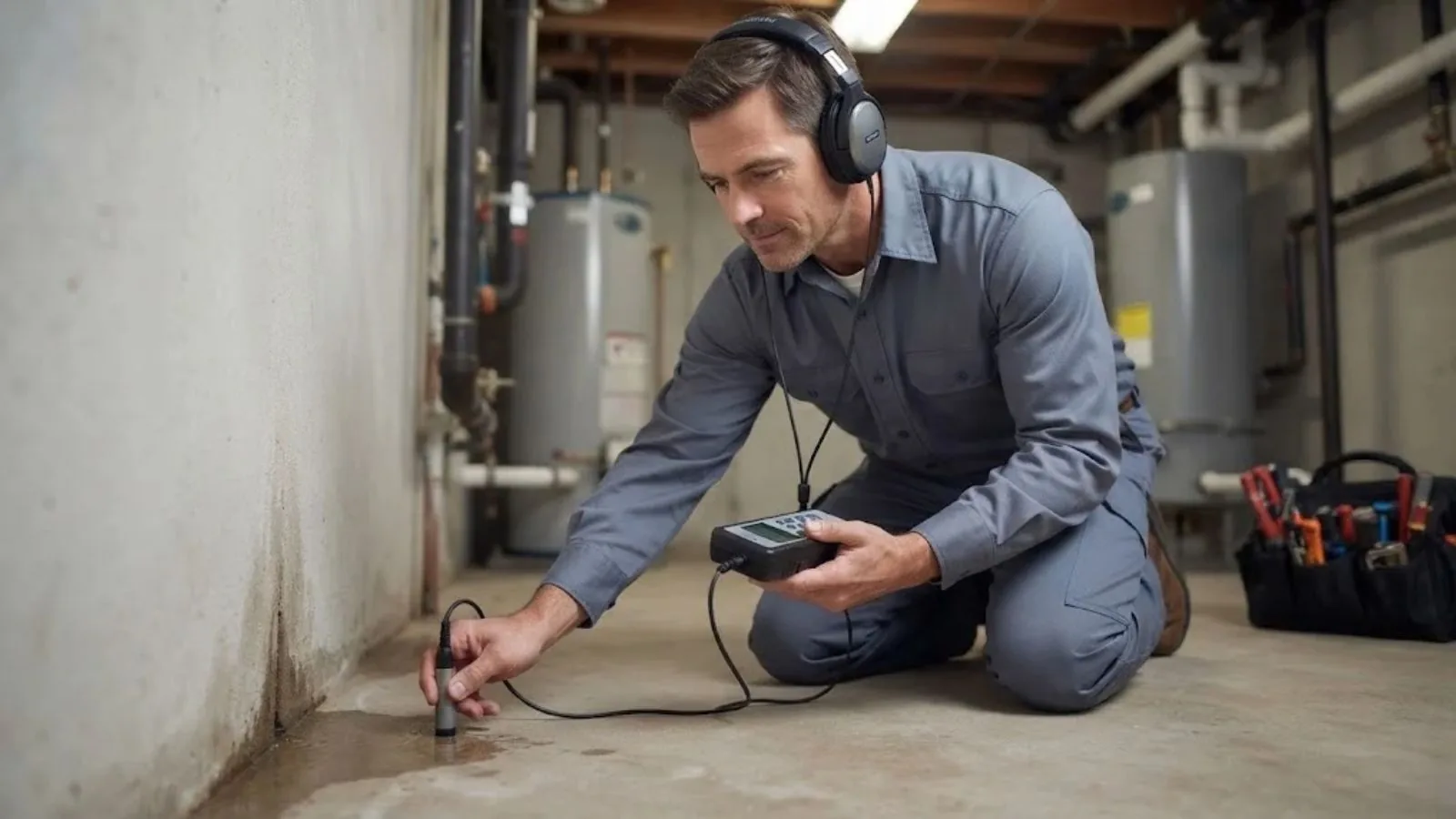
Six clues that water is escaping where you cannot see it
Hidden leaks rarely announce themselves with a puddle. They show up as small changes you can measure, hear or smell, and each change narrows down which pipe is failing. The table pairs the most common clues with their usual source.
| Clue | Common source | Best next move |
|---|---|---|
| Meter moves with every fixture off | Leak on the buried line, or a toilet running silently | Run the two-hour meter test below |
| Water bill jumps with no change in habits | Slow supply leak, worn toilet flapper or an irrigation zone stuck open | Compare three bills, then test the meter |
| Brown or bubbling ceiling stain | Supply or drain pipe above, a shower pan, or roof water | Shut off the water and watch whether the stain grows |
| Warm patch on a floor | Hot water line leaking in or under the slab | Read the slab leak page linked below |
| Hissing or trickling inside a wall | Pressurized supply pipe or a failing fitting | Close the main and listen again |
| Soggy or unusually green patch in the yard | Buried service line, sprinkler line or meter box | Check the meter box and lid area |
Not every clue is urgent. A toilet that keeps running or a faucet drip can wait for a normal visit, and same-day appointments are offered when available. A stain that is growing, a sagging ceiling, or water near outlets cannot wait.
The two-hour meter test for a high bill or a spinning meter
The EPA suggests reading your water meter before and after a two-hour period when no water is being used. If the reading moves, water is leaking somewhere. The steps below add one extra move that tells you whether the leak is inside the house or out in the yard.
- Turn off every tap, the dishwasher, the washing machine and the ice maker. Pause any sprinkler controller, and ask everyone not to flush.
- Find the meter box, usually near the curb and labeled for water. Lift the lid with a tool instead of your fingers, since insects and small animals like the space, and bail out any standing water so you can see the dial.
- Write down the full register number. Many meters also have a small low-flow indicator, often a triangle or star, that turns whenever any water passes.
- Wait two hours without using water, then read the number again. A changed reading or a turning indicator means a leak.
- Now close the main shutoff valve at the house and check the meter once more. If it stops, the leak is inside the house. If it keeps moving, the leak is on the buried pipe between the meter and your main valve.
Rule out the toilet first, because a worn flapper is the cheapest leak to fix. Add a few drops of food coloring to the tank, wait ten minutes without flushing, and look in the bowl. Color in the bowl means the flapper is leaking, and you should flush right away so the dye does not stain.
Which side of the meter is yours?
Union City's own leak guidance says a leak on the property owner's side of the meter is the owner's job to repair, while a leak on the city's side is repaired by a city water crew. Ask the city water department where its responsibility ends on your lot, and confirm the details on unioncityga.org. The Public Services line in the city's leak guidance is (770) 306-6855.
About 60 percent of Union City households rent. If you rent, photograph the meter reading and send it to your landlord, because the owner usually controls repairs on the property side.
Need leak detection help right now? Dispatch is open 24/7 and the price is explained before work starts.
Call the 24/7 line (770) 214-4545When a hidden leak is an emergency
Treat a leak as an emergency when water is touching electrical outlets or fixtures, a ceiling is bulging, floors are soaking through, or the meter is running fast enough that you can watch the dial move. At that point every hour adds damage to drywall, insulation and subfloor. The 24/7 line is open for exactly this.
- Close the main shutoff valve, usually where the water line enters the house, and open one low faucet to relieve pressure.
- If water is near outlets, appliances or the panel, stay out of standing water and switch off power only from a dry spot.
- Move rugs, electronics and furniture away from the wet area, and set a bucket under any drip.
- Take photos and short videos of the stain, the meter and the damage before cleanup starts. Insurers ask for them.
- If a pipe has actually split, the burst pipe repair page covers the first steps in more detail. Then call (770) 214-4545 and describe what you see.
Ceiling stains, wet drywall and leaks inside walls
A ceiling stain is a symptom, and the pipe that caused it is often several feet away because water runs along joists before it drips. The first job is to learn what kind of water it is. A stain that grows when nobody is using the upstairs bathroom points to a pressurized supply line. A stain that grows only after a shower or a flush points to a drain, a tub trap or a shower pan.
A stain that appears only after heavy rain often belongs to the roof, which is why attic leaks need the roof ruled out early. The plumber checks the plumbing side first, so you do not pay for a roof repair that was never needed.
A moisture meter then maps the wet area by reading how much water sits in the drywall or wood. A thermal camera adds a picture, since wet material usually shows a different surface temperature than dry material around it. Neither tool sees through a wall, so the readings guide where to look and a pressure test confirms the diagnosis.
For a pressure test, the plumber isolates a section of supply pipe, holds it under pressure on a gauge, and watches for a drop. A steady needle clears that section, and a falling needle proves a leak. Access is usually a small, neat opening that a drywall patch covers later, not a torn-out wall.
Never poke at a ceiling that is sagging with water, and keep people out from underneath it. If a light fixture is wet, leave it off until it is checked.
Damp crawlspaces and leaks under the house
Homes with a crawlspace hide leaks in plain sight, if you know where to look. Sagging insulation, a musty smell, dark rings on joists, mud under a pipe run and soft spots in the floor above are all common signs. Wet wood and insulation do not dry out on their own, so a damp crawlspace is a structural problem as well as a plumbing one.
The plumber traces supply lines first, then watches the drains while someone upstairs runs each fixture in turn. A drain leak shows up only when water is flowing, which is why it can look dry on a quiet inspection. Moisture readings on the joists show how long the area has been wet and how far the damage has spread.
If you rent, take photos from the access hatch and report them to the landlord in writing. Wood rot under a floor is slow and expensive, so a documented early report protects you both.
Buried and underground water line leaks
The service line is the pipe that carries water from the meter to your house, and it runs under the lawn, a driveway or a walk. A leak there rarely shows on the surface right away. The meter test described earlier is the best clue, since a meter that keeps moving after the main valve is closed puts the leak underground. Pinpointing the spot is the hard part.
Ground microphones listen on the surface for the sound of pressurized water escaping, and a correlator compares the noise at two points on the pipe to estimate the distance to the leak. When soil or plastic pipe muffles the sound, a tracer gas test fills the emptied line with a mix of about 95 percent nitrogen and 5 percent hydrogen. Hydrogen rises through the soil to the ground, where a sensitive probe picks it up.
Once the spot is marked, the fix depends on depth, pipe material and what sits above it. The water line repair page covers digging and trenchless options. If the leak turns out to be under the house floor, the slab leak repair page explains that route.
What each leak-finding tool actually does
Acoustic and ground microphones
They amplify the hiss or rattle of water escaping a pressurized pipe, so a technician can walk a line and find where the sound peaks.
Thermal imaging
A camera shows surface temperature differences. Wet areas and hot water lines often stand out, but the image is a clue and not proof.
Moisture meters
They read moisture inside drywall, wood and flooring, which shows how far water has spread and whether an area is still wet.
Pressure testing
A gauge on an isolated pipe section shows whether pressure holds. It separates a leaking line from one that is sound.
Tracer gas
Hydrogen mixed with nitrogen escapes through tiny openings and rises to the surface, which suits small leaks and plastic pipe where sound is weak.
A good diagnosis usually combines two or three of these, because each has blind spots. That is also why the cheapest-looking tool is not always the right one for a given leak.
Sprinkler, yard and meter-box leaks
Irrigation systems are a frequent source of high bills in the warm months. A zone valve stuck open, a broken head or a cracked lateral can run for days without anyone noticing, especially on a timer that runs before sunrise. Look for areas of lawn that stay soggy or grow greener than the rest, then turn off the irrigation supply and repeat the meter test to see whether the bill problem disappears.
A wet patch beside the curb needs a closer look at the meter box. The city's leak guidance describes saturated soil, standing water and water flowing from the meter as warning signs, and says to note whether the flow is steady or intermittent. Steady flow suggests a leak, while intermittent flow can come from nearby irrigation or construction runoff. Report suspected city-side leaks to Public Services at (770) 306-6855 before anyone digs.
Outdoor hose bibs and their feeder pipes are the other common culprit, especially after a cold snap damages them. A bib that drips inside the wall behind it can leak for months before a stain shows.
Pools and spas add one wrinkle, because evaporation and automatic fill valves hide losses. A plumber can pressure-test the supply and return lines on their own, which shows whether the loss is in the plumbing or the shell. Shell repairs belong to a pool contractor. Businesses with a hidden leak follow the same steps, and the larger systems are handled through commercial plumbing service.
What changes the price of finding and fixing a hidden leak
How many clues point to the leak
A clear meter reading plus a known stain narrows the search quickly. Vague symptoms across a whole house take more testing.
Access to the pipe
A pipe in an open crawlspace is easier to reach than one behind tile or under a slab, and the access work is part of the job.
Depth and length of buried line
A long service line under a driveway needs more listening and often a second method to confirm the spot.
Tools the job requires
A moisture scan is quick. Tracer gas needs the line emptied and isolated, which adds setup.
The repair after the find
Finding the leak and fixing it are separate tasks. A pinhole in a copper run costs less to repair than a long buried section.
Homeowners policies often treat sudden, accidental water damage differently from slow leaks and wear. Many policies pay for resulting damage but not for the pipe repair itself, and a leak that went unnoticed for months may be excluded. Ask your insurer before work starts, photograph everything, and keep the detection report.
The plumber explains the cost of the search and of any repair before work starts. Want your real number? Call (770) 214-4545.
Common questions about leak detection in Union City
Yes. The emergency line is open 24/7, including nights, weekends and holidays. Tell the dispatcher what you see, where your main shutoff is, and whether the meter is moving, and the licensed plumber can plan the right tools.
Turn everything off and read the meter, wait two hours, and read it again. Normal use stops when taps are off. A moving dial or a turning low-flow indicator means water is escaping, and closing the main valve tells you whether the leak is inside or outside the house.
Usually, yes. Moisture meters, thermal imaging, listening devices and pressure tests locate most leaks before anything is opened. The plumber then cuts a small access point at the confirmed spot instead of exploring.
According to Union City's leak guidance, a city-side leak is repaired by a city crew and an owner-side leak is the owner's job. Where one ends and the other begins depends on your lot, so ask the city water department and check unioncityga.org.
It can be either. Staining that grows only after rain suggests the roof, and staining that grows with no rain or when a fixture runs suggests a supply or drain line. A moisture scan and a pressure test sort it out in one visit.
Outdoor leaks are common and usually easy to isolate. Shut off the irrigation supply or the bib's valve, repeat the meter test, and if the meter stops, you have found the area. A plumber can then repair or replace the failed section.
That depends on your lease and your landlord's responsibilities. Report the leak in writing with photos right away, and avoid hiring someone yourself before the landlord agrees. About 60 percent of Union City households rent, so landlords field these calls often.
Leak Detection across Union City and nearby towns
Leak detection visits cover Union City and nearby towns, including Fairburn, Palmetto, South Fulton, College Park and Riverdale.
Questions about leak detection? Call the line and describe what you see.
Call (770) 214-4545