
Red clay, rainfall and the slab your house sits on
Union City sits in Georgia's Piedmont, where the typical upland soil is a sandy loam on top of red clay. The USDA's description of the Cecil series, a common Piedmont soil, lists well drained red clay subsoil and roughly 45 to 55 inches of rain a year. That rainfall pattern means the ground under a slab does not stay at one moisture level. It is wetter after a long run of storms and drier after a dry stretch.
Clay changes volume as its moisture changes. Engineering writing on clay soils explains that differential moisture, wet in one zone and dry in another, is what makes the soil swell or shrink, and a slab-on-grade foundation tends to follow that movement. Leaking pipes, poor drainage and trees are all listed as sources of moisture change. Whether a given lot moves enough to strain pipes varies with drainage, grading and trees, so no one can promise it from the street.
What this means for you is practical. A slab leak adds water to the soil under the house, and that wet pocket can itself shift the ground and make the damage grow. If you also see new cracks in drywall, doors that stick, or gaps at trim, mention them when you call. They help the plumber decide how urgently to confirm the leak.
Signs the leak is under the slab
A warm spot on the floor
A hot water line leaking beneath the slab can warm the concrete above it. Bare feet find it before any instrument does.
The sound of running water
A hiss or trickle with every tap off, heard best at night, can mean a pressurized line is leaking below you.
A meter that will not stop
If the meter turns after everything is off and the main valve at the house is closed, the leak is outside the house. With the main open and nothing running, a turning meter is only a first clue.
Damp carpet, buckling floors or wet baseboards
Water finds the path of least resistance, so it can surface a long way from the actual break.
A sudden bill spike or low pressure
A leak lets water escape before it reaches fixtures, so the bill rises while pressure falls.
Any one of these has other causes. A warm floor can come from a heating duct, and a damp wall can come from a roof. That is why a slab leak is confirmed by testing, not guessed from symptoms alone.
Need slab leak repair help right now? Dispatch is open 24/7 and the price is explained before work starts.
Call the 24/7 line (770) 214-4545When a slab leak is an emergency
Treat it as an emergency when water is rising through flooring, a hot water line is clearly losing water into the house, the meter is racing, or wet floors are spreading toward electrical outlets. Hot water leaks also waste energy, since the water heater keeps working to replace what escapes. A slow, steady leak under a tiled room is serious but usually gives you time to plan.
- Close the main shutoff valve at the house. That stops water feeding the break.
- Open one faucet at the lowest point to drain pressure from the system.
- Switch off power to any wet area only from a dry position, and stay out of standing water.
- Lift rugs and move belongings to dry ground.
- Photograph the damage, the meter and any warm spots before cleanup.
- Call (770) 214-4545. The line answers 24/7 and a licensed plumber can plan the next steps.
Do not drill or break concrete yourself. Pipes, wires and the slab's reinforcing can sit close together, and a wrong hole makes the repair harder.
How a leak under concrete gets found
Detection comes before any repair, and it should be a process of elimination instead of a guess. The plumber first runs the meter test, then closes valves to separate hot and cold lines. Hot lines are the usual suspects, since a warm floor usually points to a hot line. Details on the tools are on the leak detection page.
Next comes listening. An electronic listening device on the floor and at fixtures picks up the sound of water leaving a pressurized pipe, and the loudest point marks the zone. A thermal camera can show a warm stripe on the floor where a hot line is leaking. A pressure test on an isolated line confirms which pipe is failing, so the repair opens one spot, not three.
If sound is weak, tracer gas can pinpoint it. The line is emptied, filled with a nitrogen and hydrogen mix, and a probe at floor level finds where the hydrogen escapes. Spots are then marked on the floor with paint or tape before any cutting starts.
Repair options for a pipe under the slab
There is no single right answer. The choice depends on how many leaks the house has had, what the pipe is made of, and how much disruption you can accept. Ask the plumber to lay out at least two options and explain what each one will not fix.
| Option | What happens | Fits best when | Trade-off |
|---|---|---|---|
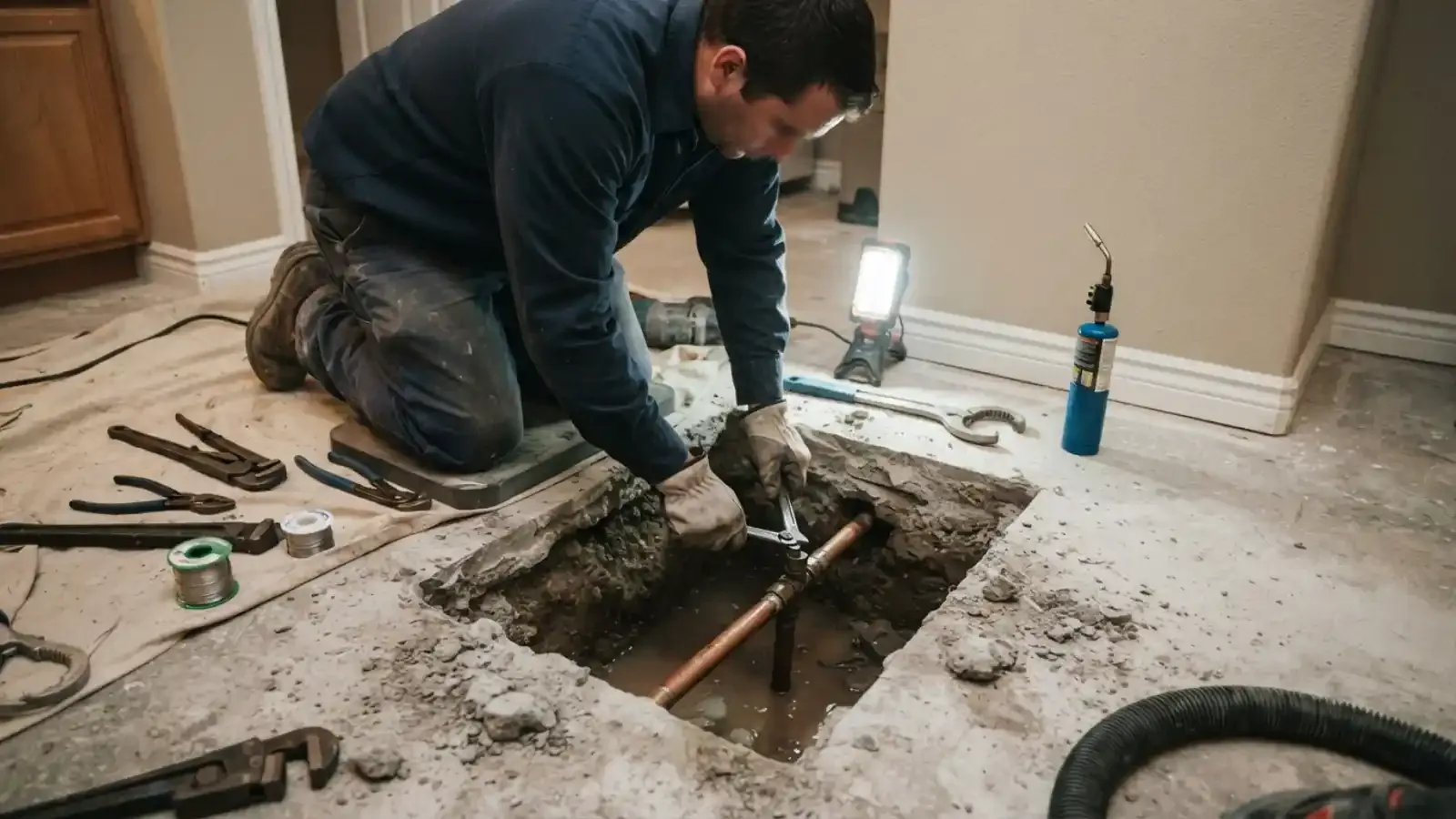
| Spot repair through the slab | A section of concrete is broken, the bad piece of pipe is cut out and replaced, and the slab is patched | One isolated leak in otherwise sound pipe | Other weak spots in the same pipe can fail later, and flooring above is disturbed |
| Reroute the line overhead | The failing line is abandoned and new pipe runs through attic, walls or ceilings | Repeated leaks in one line, or a line under tile you want to keep | Walls and ceilings need access holes and patching |
| Epoxy lining | The inside of the pipe is dried, cleaned and coated with a resin that cures in place | Small leaks in pipe that is otherwise intact and accessible | Not suited to every pipe or fitting, and some repipe specialists advise against it for drinking water lines |
| Whole-house repipe | All supply lines are replaced with new pipe | Widespread corrosion or several leaks across the house | Largest job and the most patching, but it ends the pattern |
For homes with repeated leaks in the same line, the repiping page explains when replacing everything costs less trouble than patching one spot at a time. Epoxy lining makers describe a pipe within a pipe, but the cure takes hours to days and water stays off until then, so ask about warranty terms and the product's drinking-water certification before agreeing.
Leaks under a concrete driveway or walkway
The water service line often crosses a drive or walk on its way to the house, and a leak there can look like a slab leak from inside. A soft patch at the pavement edge, a dip in the driveway, or water seeping through a crack are the outdoor clues. The meter test cannot tell the two apart. A closed main valve with a still-moving meter says only that the leak is between the meter and the house.
Listening on the pavement and tracer gas help locate it. Repair then runs through one of two routes, cutting a trench through the drive or running a new line around it. Call 811 before any digging so buried utilities are marked, and see the burst pipe repair page if a joint has actually failed.
Renters, landlords and insurance paperwork
About 60 percent of Union City households rent, so many slab leaks start with a tenant noticing a warm floor or a bill. If that is you, report it to the landlord in writing with photos, and keep your own copy. The owner controls the building and its pipes, and a repair done without permission can cause a dispute.
For owners, insurers generally separate sudden, accidental damage from wear and slow leaks. A common pattern is that the policy may pay for resulting water damage but not for the cost of repairing the pipe itself. Take dated photos before cleanup, save receipts for emergency steps, and tell the insurer early.
What to keep for a claim
Photos or video of damage, the meter reading, and any warm or wet areas before drying starts. Receipts for fans, towels and emergency steps. The plumber's written findings, including where the leak was confirmed.
Code under the slab
Plumbing under a slab must meet the International Plumbing Code (IPC), the base of Georgia's state plumbing code. A reroute overhead or a spot repair through the slab are the two usual approaches, and either may involve a permit. Call Union City Community Development at (770) 515-7920 if you are unsure.
What to do if you suspect a slab leak
Turn off every fixture and check the meter. If it keeps moving, close the main valve at the house and call the 24/7 line. Keep electronics and cords off damp floors, and do not stand in water near outlets.
What changes the price of a slab leak repair
How the leak is reached
Breaking concrete in a bare garage takes less labor than lifting tile or hardwood, so the room above matters.
Number and location of leaks
One confirmed leak is a spot repair. Several leaks usually point toward a reroute or a repipe.
Pipe material and age
Copper that has pinholed in several places tells a different story from a single damaged fitting.
Detection effort
A loud leak is quick to pinpoint. A quiet one takes tracer gas or longer testing.
Restoration afterward
Concrete patching is part of the work, while new flooring, drywall paint or carpet may be a separate trade.
Policies commonly distinguish a sudden break from damage that built up slowly, and many exclude the pipe repair itself while covering the resulting water damage. Coverage depends on your wording and endorsements, so call your insurer before work begins and ask what documentation they want.
A clear price is given before work starts, and a written explanation of options helps your insurer or landlord too. Want your real number? Call (770) 214-4545.
Common questions about slab leak repair in Union City
Yes. The emergency line is open 24/7. Close the main shutoff, call, and describe where you see water or feel warmth so the licensed plumber can prepare the right detection tools.
It does not prove it, but it points toward one. If the meter turns with every fixture off and the main closed at the house, the leak is on the line between meter and house. Whether that line is under the slab, a drive or the yard takes listening and testing to settle.
A spot repair opens one small area of concrete, and flooring above it is lifted or cut. A reroute through the attic avoids the slab but needs patches in walls or ceilings. The plumber should show you the planned path before anything is opened.
It suits some small leaks in sound, accessible pipe, but it is not right for every case. Ask whether the product is certified for drinking water, how long water stays off, and what happens if the lining fails.
Water lines do cross drives on the way to houses. The leak is located first, then repaired by cutting a trench or running a new line around the pavement. Call 811 before digging so buried utilities are marked.
Often the resulting water damage is covered when the break was sudden, while the pipe repair itself is not. Wear, corrosion and slow leaks are commonly excluded. Photograph everything and ask your insurer before work begins.
Tell your landlord first, in writing, with photos. If water is spreading and you cannot reach the owner, close the main valve and document the damage. Ask the landlord who should authorize the repair.
Slab Leak Repair across Union City and nearby towns
Slab leak calls come from across Union City and neighboring towns such as South Fulton, College Park, Riverdale, Fairburn and Palmetto.
Questions about slab leak repair? Call the line and describe what you see.
Call (770) 214-4545