
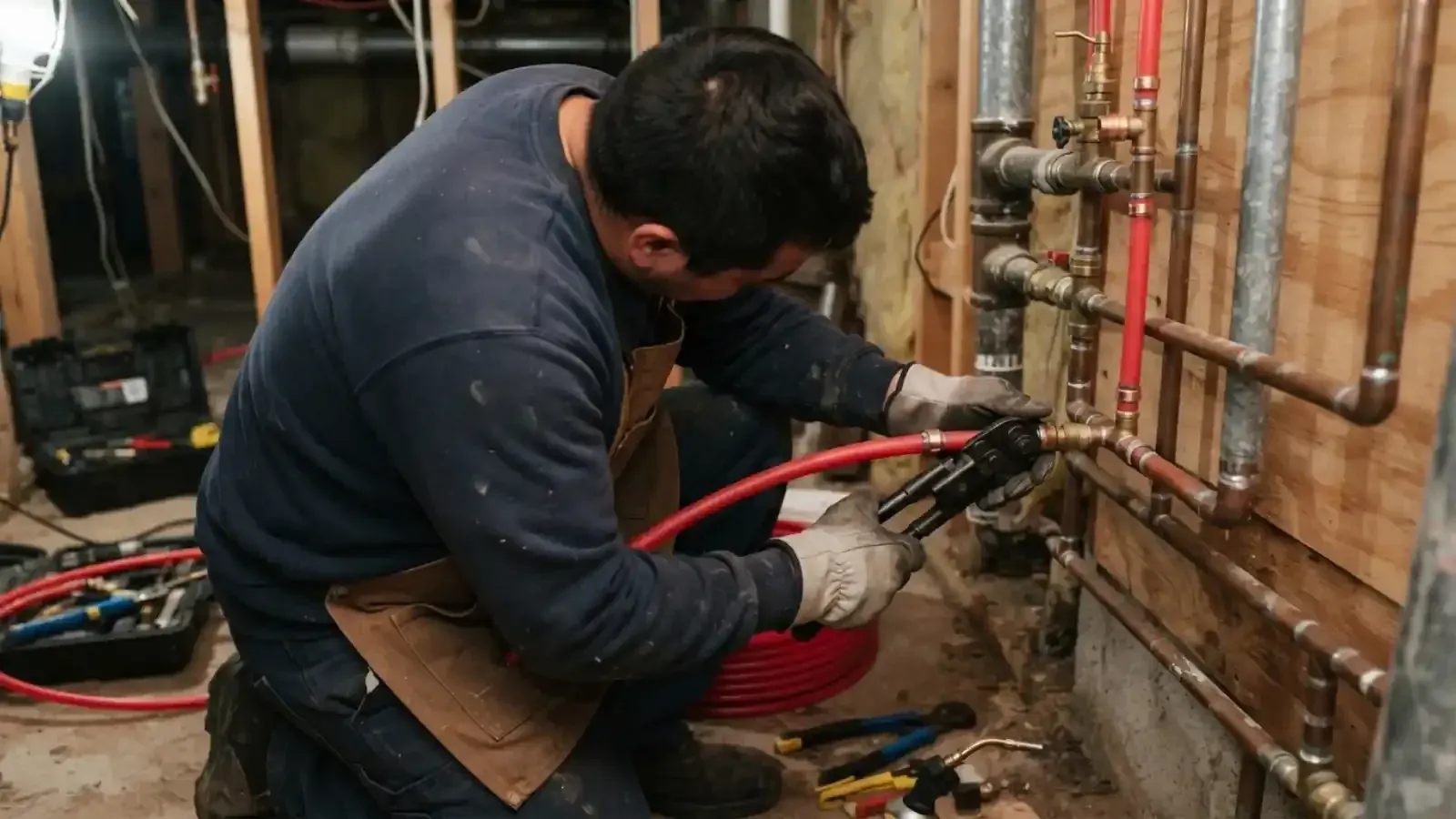
What PEX is and why plumbers use it for repipes
PEX is polyethylene whose molecules are cross-linked, which makes it flexible and tough. It bends around corners, so a long run needs far fewer elbows than copper does. Fewer joints means fewer places a leak can start.
It is also less likely to burst from freezing than copper or rigid plastic pipe, because the tubing can expand slightly. That matters in Georgia, where hard freezes are rare but do happen. Metro Atlanta saw burst pipes and water main breaks in the January 2024 cold snap, and a master plumber told local news that many Georgia homes have little pipe insulation. PEX is not freeze-proof, so insulate exposed runs anyway.
PEX-A, PEX-B, and PEX-C are not the same
The letters describe how the tubing is cross-linked during manufacturing. All three are sold for potable water, but they handle a little differently on the job.
| Type | How it is made | What installers notice |
|---|---|---|
| PEX-A | Peroxide method, cross-linked while hot | Very flexible and kink-resistant, and works with expansion fittings |
| PEX-B | Silane method, cured with moisture after extrusion | A bit stiffer, widely sold, and commonly used with crimp or clamp rings |
| PEX-C | Electron beam, cross-linked while cold | Less uniform above 1 inch, and handled more carefully |
The right pick depends on the fitting system, the tubing available, and the plumber's tools. Mixing brands of tubing and fittings is a common error, so the whole system should match the manufacturer's listed pairings.
Not a good time for a DIY fix? The 24/7 line is open and the price comes first.
Call the 24/7 line (770) 214-4545Choosing a layout, manifold or trunk and branch
Layout is the biggest design decision. It changes how many fittings go in the walls, how fast hot water arrives, and where shutoffs live.
Home-run manifold
A central manifold feeds a separate line to every fixture. Each fixture gets its own shutoff, and fewer joints end up inside walls.
Trunk and branch
A larger trunk line runs through the house with smaller branches to fixtures. It resembles traditional copper plumbing and uses less tubing.
Hybrid
A manifold serves distant bathrooms while a short trunk covers fixtures clustered together. Many houses suit this mix.
A manifold uses more tubing, but it lets you shut off one sink without losing the whole bathroom. Trunk and branch costs less in materials and delivers pressure evenly when sized correctly. Ask your plumber to explain the choice for your floor plan instead of defaulting to one.
Fittings, crimp, clamp, expansion, and push-fit
The fitting system is where PEX jobs succeed or fail. Each method needs its own tool, and installers must follow the manufacturer's steps exactly.
- Crimp rings are squeezed on with a crimp tool, and a go/no-go gauge checks every joint.
- Clamp rings are cinched with a clamp tool, which suits tight spaces and reduces the need for a gauge.
- Expansion fittings use a tool that stretches the tubing end so a ring and fitting seat inside it, and the tubing then shrinks back tight.
- Push-fit connectors need no special tool and are handy for repairs, but they cost more per joint and are often kept out of walls.
- Compression fittings tighten with wrenches and can be taken apart, which makes them popular for fixture stops.
Each system needs its own tool kit, so a plumber who owns the right tools for the chosen fitting is a good sign. A bad crimp leaks behind drywall, so every joint should be tested before it is closed up.
Chemicals, sunlight, and brass, the cautions that matter
PEX breaks down in sunlight. Store it away from direct light and shield it after installation. Some tubing includes UV blockers, but those give only limited protection, so a long run near an unshaded window or in a bright garage should be sleeved or covered.
Chemicals can also shorten its life. Tubing contains antioxidants that help it resist chlorine, but some adhesives and sealants on the pipe surface can weaken those antioxidants. Foam pipe wrap has not been linked to that problem. Use only products labeled safe for PEX when you seal around it.
Brass fittings count too. Yellow brass with about 30% zinc led to dezincification failures in Nevada, and red brass with 5 to 10% zinc replaced it. A related product called Kitec was discontinued after widespread failures tied to brass fittings. Ask what fitting alloy your plumber is installing.
How a PEX repipe runs on site
- Shut off the main, drain the lines, and photograph every fixture location.
- Install the manifold or trunk near the water heater, with room to reach shutoffs.
- Pull the tubing through wall cavities, attic, or crawlspace, using sleeves where it passes through framing.
- Make connections to fixtures, the water heater, and the main with the matching fitting system.
- Pressure-test the system and check every joint before walls are closed.
- Patch drywall, label the manifold valves, and give the owner a map of the lines.
A whole-house repipe on a typical home often takes more than one working day, with the water off for much of it. Slab houses add a rerouting step, since the old buried lines are usually capped and abandoned. Our repiping service page explains how that scope is set.
Licensing, permits, and where DIY stops
The tubing is friendly, and plenty of homeowners can cut and crimp a fixture stop. A whole-house repipe is different. It ties into the main, the water heater, and every fixture, and a hidden leak can ruin a ceiling before it shows.
In Georgia, plumbers are licensed through the State Division of Master and Journeyman Plumbers. Class I Master licenses cover single-family homes and dwellings up to two families. Class II Master has no size limits. You can check any plumber by name in the state licensee search before you sign anything.
The city says permits are issued to the certified contractor. That suggests a homeowner may not be able to pull the permit alone, so ask Union City Community Development before you buy a roll of tubing. A repipe done without a permit can raise questions during a sale or an insurance claim.
New builds and remodels, a different case
PEX shows up in new work too. When a bathroom is added or a kitchen is gutted, a plumber can run new lines before the walls close, which is cheaper in labor than opening finished rooms. If you are planning an addition, new plumbing installation covers the rough-in and fixture side.
Landlords who repipe a rental should ask for the manifold map and keep it with the lease file. Tenants should report low pressure or discolored water in writing so the repair is tied to a date.
Sharing the work with a licensed plumber
Homeowners can legitimately help by clearing access, moving furniture, and labeling shutoffs. Drywall patching and painting can be separate trades. The tie-ins, pressure test, and permit belong to the licensed contractor.
If you own a similar house in South Fulton or Palmetto, the same steps apply. Each place has its own permit office, so ask the local authority which rules cover your address.
PEX and code
PEX is an approved supply material under the International Plumbing Code (IPC), the base of Georgia's state plumbing code, when it is listed to the right standard and installed with matching fittings. Ask your plumber which listing marks are on the pipe and how the permit is handled in Union City.
PEX repiping rules and water facts in Union City, GA
Union City's water comes from the City of Atlanta, and the city's 2023 water quality report lists chlorine as the disinfectant, with an average of 1.09 ppm and a range of 0.0 to 1.93 ppm. PEX is made to tolerate chlorinated municipal water, so this is normal for the pipe. Keep adhesives and sealants off the tubing, since those can weaken its chlorine protection.
The report does not list water hardness or pH, so ask the city water department at (770) 306-6855 for its latest report. If you want the numbers for your own tap, a test kit gives a baseline before the repipe.
The city's permit page says permits are required for alteration and repair, issued to the certified contractor, under the 2018 International Plumbing Code with Georgia amendments. Permit rules vary by job, so call Union City Community Development at (770) 515-7920 before work starts and ask what the inspection will check.
Questions homeowners ask
Small fixes are one thing and a whole-house repipe is another. Union City's permit page says permits are issued to the certified contractor, so ask Community Development at (770) 515-7920 whether an owner can pull one. Also ask your insurer how unlicensed work affects coverage.
Neither is better in every case. PEX-A is more flexible and works with expansion fittings, while PEX-B is stiffer and commonly joined with crimp or clamp rings. The right choice is the one that matches the fitting system on the job.
A manifold sends a separate line from one central point to each fixture. Trunk and branch uses a main line with smaller branches, like traditional plumbing. The first uses more tubing and the second more joints.
Yes. The tubing carries antioxidants that help it handle chlorine, and the city reports an average of 1.09 ppm in its 2023 report. Avoid adhesives and sealants that touch the pipe surface.
Not unprotected. Sunlight breaks it down, and UV blockers in the tubing give only limited protection. Run it indoors or cover and sleeve any exposed length.
Call Union City Community Development at (770) 515-7920. The city says permits cover construction, alteration, and repair. Then call (770) 214-4545 to schedule a licensed plumber who can pull the permit.