
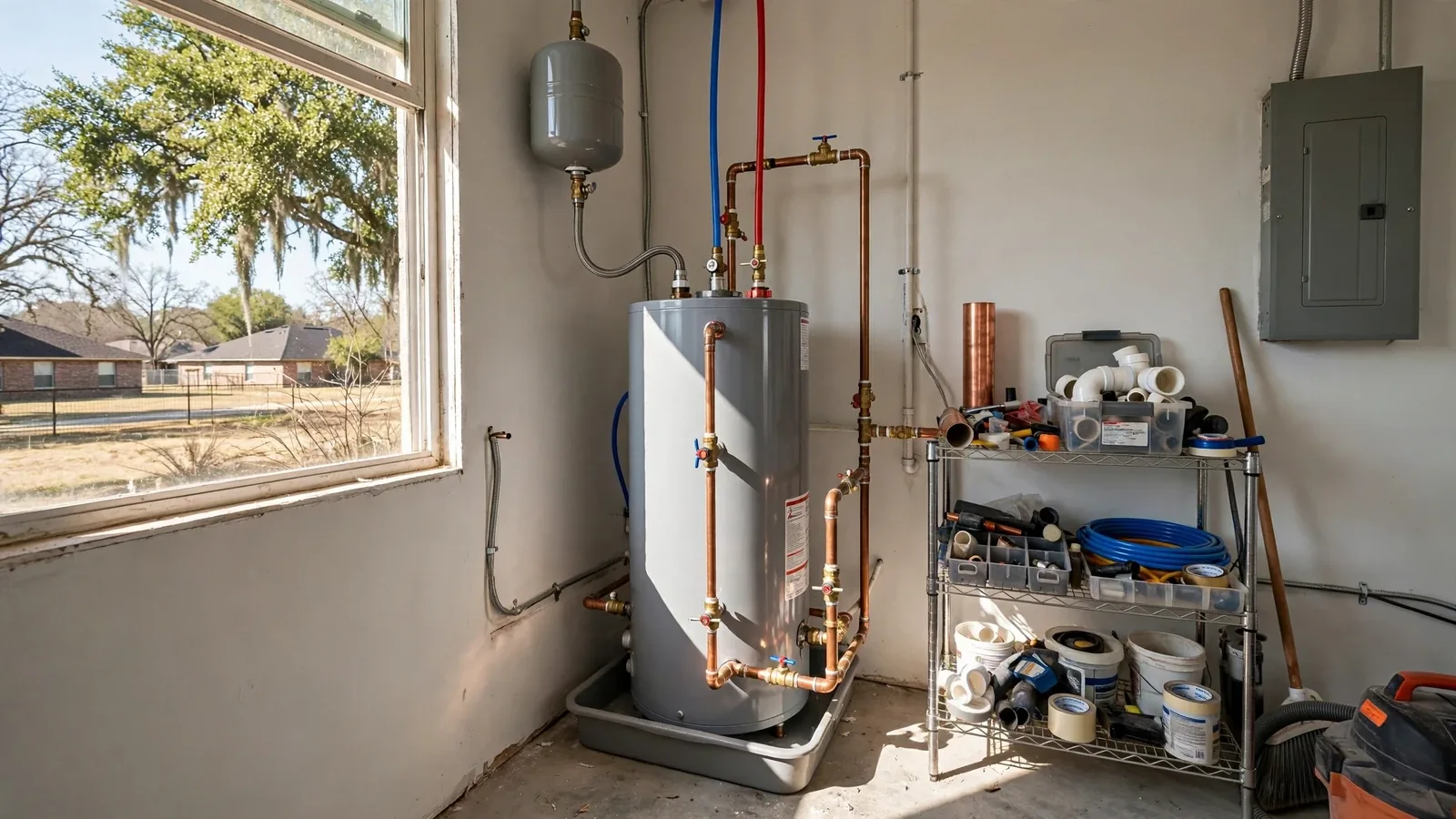
How the day goes, from the first shutoff to the first hot tap
- The plumber walks the site, checks the old unit's fuel, size, and venting, and confirms the plan for the new one.
- Power or gas goes off, the cold supply is closed, and the old tank is drained to a floor drain or the yard through a hose.
- The old heater is disconnected, the water lines and vent are separated, and the tank is moved out.
- The new unit is set in a drain pan, leveled, and connected to new flex lines or copper with shutoff valves and a dielectric fitting where metals differ.
- Gas lines are connected and leak-checked, or the electric circuit is wired to the unit. Vent pipe is rebuilt to the maker's required slope and clearances.
- The relief valve gets its discharge pipe, the tank fills with the hot taps open to bleed air, and then the power or gas is restored.
- The plumber tests temperature at a tap, checks for leaks and combustion safety, and hauls the old tank away.
A swap of the same fuel and size in a clear closet is a matter of hours rather than days. Conversions, relocated heaters, and tight attics take longer. The plumber should tell you the scope at the walkthrough so there is no surprise at the end.
Before the crew comes, what to prep
Clear a three-foot path from the door to the heater and move stored boxes off the floor around it. Tell everyone when the water will be off, since hot and cold both go down during the swap. Know where your main shutoff is and make sure it turns, because a stuck main valve is a common delay.
- Find the data label on the old tank and note fuel type, capacity, and age.
- Check for a floor drain nearby and a safe place to run the drain hose.
- For a rental, get written approval from the landlord so the work can begin when the plumber arrives.
- Plan for a few hours without hot water and bring in bottled water for drinking if needed.
Ready to book water heater installation? Same-day appointments are offered when the schedule allows.
Call (770) 214-4545Code items that belong on every install
The relief valve is the final safety device on the tank. Watts says residential valves are typically rated to open at 150 psi and 210 degrees Fahrenheit, and the discharge pipe must be the valve's size and slope downward to a safe place. The plumber should never cap, plug, or reduce that line.
An expansion tank handles thermal expansion in a closed system. A check valve or backflow preventer on the supply blocks expanding water from flowing back, so pressure builds in the tank. The Jordan Valley Water Conservancy District explains that the expansion tank is the second safety device, and a dripping relief valve is often the first sign you need one.
A drain pan with a pipe to a safe drain protects a ceiling or finished floor below the heater. Union City's permit page lists the 2018 International Plumbing Code and International Fuel Gas Code with Georgia amendments. Permit rules vary, so ask Union City Community Development at (770) 515-7920 how a swap is handled.
Tank, hybrid heat pump, or tankless, choosing before you buy
| Type | Space and utilities | Main trade-off |
|---|---|---|
| Standard gas tank | Gas line, vent, combustion air | Fast recovery, but needs a safe flue |
| Standard electric tank | 240-volt circuit | Simple, with higher operating cost than a heat pump |
| Hybrid heat pump tank | 240-volt circuit, 1,000 cubic feet of air at 40 to 90 degrees | Two to three times as efficient, but costs more upfront |
| Gas or electric tankless | Larger gas line or heavy electric service, a vent for gas | Endless hot water, but higher install cost and yearly maintenance |
The U.S. Department of Energy says heat pump water heaters cost more upfront, and lower operating costs can offset the difference over time. They cool the surrounding air, so they suit a garage or a large utility room better than a small interior closet.
If you are considering demand-style heating, read the tankless water heater page for the install and upkeep details. If you are undecided about moving a heater or adding new fixtures, plumbing installation covers the rough-in side of that work.
Sizing the unit and fitting it to the household
The Department of Energy sizes storage heaters by first hour rating, matched to your busiest hour. Add up showers, dishwasher, and laundry in that hour and pick a unit that meets or exceeds the total. Their worked example comes to 66 gallons for three showers, a shave, and handwashed dishes.
A Union City household averages roughly 2.47 people, according to Census QuickFacts, but averages hide the big family and the single renter. Tell the plumber who lives there and the hour everyone bathes. That detail is more useful than the square footage.
Hauling the old tank and what comes after
Even a drained tank is bulky and catches on doorframes, stairs, and tight turns. The crew removes it and takes it away so it does not sit in your garage. Ask at the walkthrough whether haul-away is on the written quote.
After the install, keep the manual and register the warranty. Set a yearly reminder to check the relief valve for drips and the area for moisture. A quick glance at the pan and the connections can catch a small problem before it grows.
Rentals and Union City particulars
Owners occupy only 40.4 percent of Union City homes, so many installs are ordered by a landlord rather than the person who lives there. If that is your building, ask whether the plumber can coordinate with the property manager. A tenant should never sign off on a new tank without the owner's approval.
The city buys treated water from Atlanta and does not list hardness in its quality report. Test your tap before you choose a tank, and ask the water department at (770) 306-6855 for the report. If your water is hard, scale will shorten the life of any heater, so a plan for flushing belongs in the decision.
What changes the price of a water heater installation
Type and capacity
A conventional 40-gallon tank, a larger family tank, a heat pump unit, and a tankless unit all sit at different price points.
Fuel and utilities
A gas line that needs resizing or a new 240-volt circuit adds parts and labor to the job.
Venting and code work
New flue pipe, an expansion tank, a drain pan, and a relief valve discharge line are common additions.
Location and access
A garage is easier than an attic or crawl space. Moving a heater to a new spot adds supply, drain, and vent changes.
Permit and haul-away
The permit process and the removal of the old tank are part of the scope. Ask what your quote includes.
A planned installation is a maintenance or upgrade expense, so homeowner insurance usually does not pay for it. If an old tank has already flooded the house, the water damage may be covered as sudden and accidental, so call your insurer first. Ask your landlord for approval if you rent.
The price you see should include every part on the list we agree on. Want your real number? Call (770) 214-4545.
Common questions about water heater installation in Union City
A like-for-like swap in an accessible spot usually takes a few hours. Fuel conversions, relocations, and new venting take longer, and the plumber should explain the scope before starting.
If a check valve or backflow preventer blocks flow back to the supply, you likely do. A relief valve that drips whenever the heater runs is a common sign.
It is a shallow pan under the heater with a pipe to a safe drain. It matters most when the heater is in a closet or attic above finished space.
Department of Energy guidance says air-source units do better in warm climates, and they need a space that stays between 40 and 90 degrees with about 1,000 cubic feet of air.
Yes. The old tank is drained, disconnected, and taken away as part of the job.
Permit rules vary, so ask Union City Community Development at (770) 515-7920. The city issues permits to the certified contractor.
Same-day appointments are available when the schedule allows. If your tank is leaking now, call the 24/7 emergency line instead.
Water Heater Installation across Union City and nearby towns
Installation visits cover Union City plus Palmetto, Fairburn, South Fulton, College Park, and Riverdale.
Questions about water heater installation? Call the line and describe what you see.
Call (770) 214-4545