
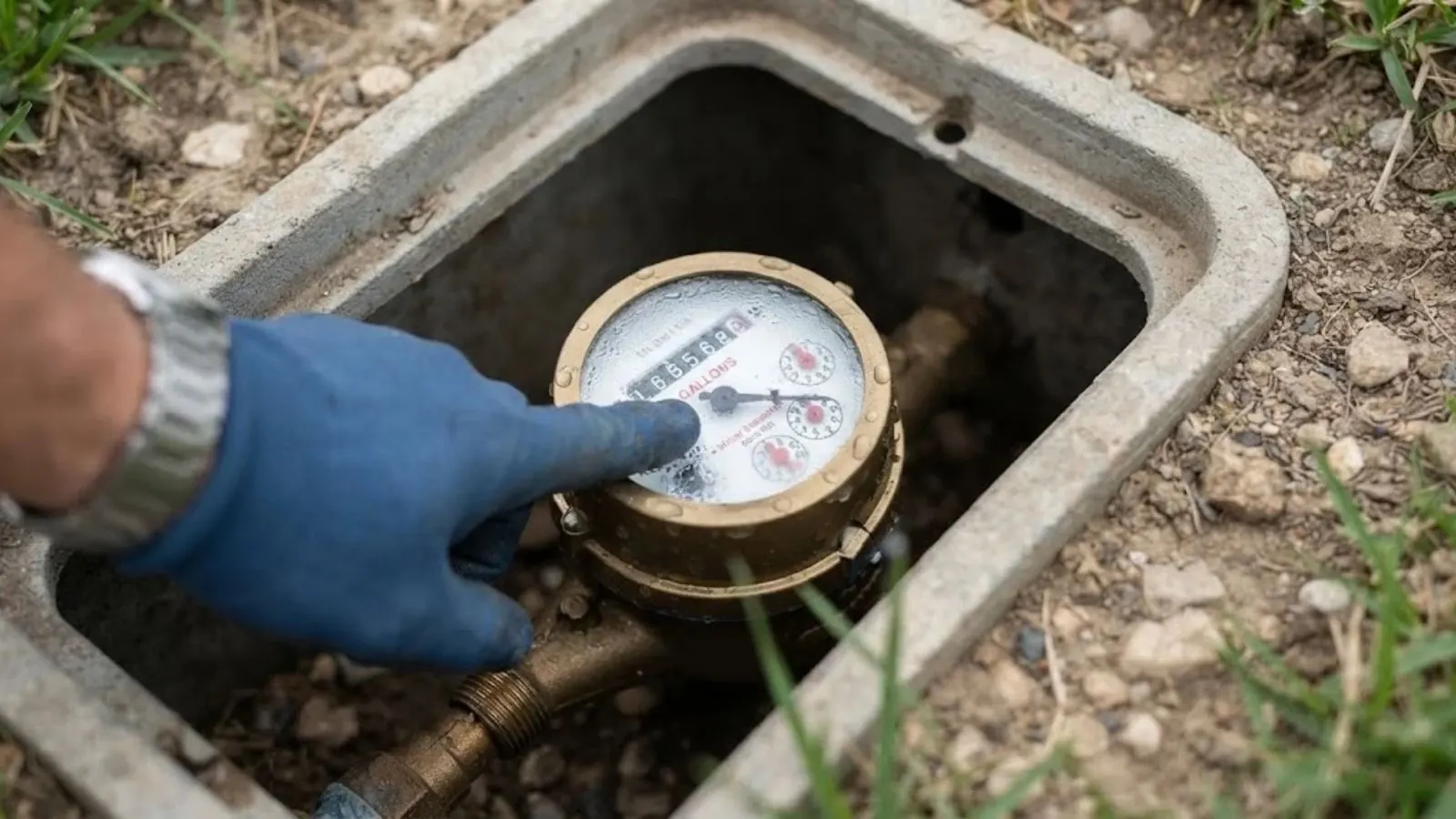
What a moving meter with everything off means
A water meter counts every gallon that passes through the service line. If the dials move when nobody is using water, then something is using it, or losing it. The leak could be inside the house, in the yard, or on the city's side of the meter.
Most modern meters have a small low-flow indicator, often a triangle, star or tiny wheel on the face. It spins at very low flow, so even a slow drip makes it turn. Some utilities call it a flow finder or test circle. If it moves with all water off, treat that as a leak until proven otherwise.
Intermittent movement is different. A meter that moves for a few minutes, stops, then moves again can mean a toilet refilling, an ice maker, a water softener cycle or an irrigation timer. A steady, constant spin points to a true leak.
How to read the dials and units on your bill
Open the meter box carefully with a large screwdriver, never your fingers, because insects and animals shelter inside. The odometer-style digits show total volume since the meter was installed. Many meters count in cubic feet, and one cubic foot is about 7.48 gallons.
Your bill may show gallons, thousands of gallons or billing units. Check the small print on your own statement before you compare numbers, because units differ between utilities. A mix-up here can make a normal bill look wrong or a leak look small.
- Take a photo of the meter face and the low-flow indicator before you start.
- Close every faucet and stop all irrigation, then watch the indicator for two minutes.
- Close the main shutoff valve at the house and watch again.
- If the indicator stops, the leak is inside the house. If it keeps moving, the leak is on the outdoor line or the city side.
- Write down the date, time and readings, and keep the photo for any call to the city.
That house valve test works because it splits the system in two. It is the same split the city uses when it decides who repairs a leak. The EPA also describes a simpler test, where you read the meter, wait two hours with no water use, and read it again. Any change means a probable leak.
Not a good time for a DIY fix? The 24/7 line is open and the price comes first.
Call the 24/7 line (770) 214-4545Leak or just normal use
Not every high bill is a leak. A new baby, house guests, a filled pool, new sod or a longer billing period all raise usage. A leak is the explanation when the meter runs with no one using water, or when usage stays high week after week with no change in habits.
| What you see | Likely cause | First move |
|---|---|---|
| Meter moves steadily with all water off | Leak inside or outside the house | Do the house valve test, then call |
| Meter moves in short bursts | Toilet flapper, ice maker or irrigation timer | Dye test the toilets and check timers |
| Bill up, meter stops when all off | Higher use, longer billing period or rate change | Compare days in the cycle and last year's same month |
| Wet spot in yard, meter moving | Service line leak | Note the spot and call for locating |
| Bill spiked once, then returned to normal | One-time use, such as filling a pool or a stuck valve | Think back to what changed that month |
The EPA estimates that nine percent of homes leak 50 gallons or more per day. That is why a bill that quietly creeps up deserves a meter check even when nothing looks wrong. It is also why fixing an easy leak can save roughly ten percent on a water bill, according to the EPA.
What to compare on your Union City water bill
Start with the dates. Look at how many days the billing period covers and compare it with last month and the same month last year. A bill that covers 35 days uses more than one that covers 28, even if your habits never changed.
Then look at the usage figure, not the total. Rates, base charges and sewer charges can change the total even when usage is flat. Union City's rates page says a three percent increase in water and sewer rates took effect September 1, 2026, and that the effect on a monthly bill varies with how much water you use. A small rise on the first bill after that date may be the rate, not a leak.
The city also runs three billing cycles, and the date on your bill depends on where your property is. If your bill arrives later or earlier than a neighbor's, that is the cycle, not an error. Use the same cycle dates when you compare months.
Common reasons a meter runs when nothing seems to be on
- A toilet flapper that seeps water from the tank into the bowl, which the EPA says is often the culprit in household leaks.
- An irrigation zone stuck open, a cracked head or a broken line, since the EPA says a 1/32 inch irrigation leak can waste about 6,300 gallons a month.
- A dripping hose bib or a hose left connected to a leaking fitting.
- A water heater relief valve or supply connection weeping into a drain.
- An ice maker line or filter connection behind the refrigerator.
- A leak on the service line between the meter and the house, which is out of sight under soil.
Rule out the cheap suspects first. If the toilet dye test passes and the irrigation is off at the controller, the remaining list gets shorter and more expensive. At that point a pro with listening equipment saves the time you would spend guessing. Locating the leak is exactly the work described on the leak detection service page.
Who to call first, the city or a plumber
Call the city first if the water is visible at or before the meter, if the meter box is full of flowing water, or if neighbors report low pressure or a wet street. Those signs point to the public side. The city repairs leaks there and, per its leak guidance, does not charge you for water that leaks on the city side.
Call a plumber if the house valve test shows the leak is on your side, if you see a wet spot between the meter and the house, or if the meter stops with the valve closed. A buried line failure is a job for water line repair, and a locate call to Georgia 811 comes before any digging.
The same steps apply to homeowners in Palmetto and Fairburn, although your water provider may be a different utility, so confirm who reads your meter.
If you cannot tell which side is leaking, call the city anyway. It will help you identify the source, and you can note the date of your report. That date is useful later if you ask about the bill.
Questions to ask when you call about the bill
Have the account number, the meter readings and your photo ready. Ask whether the meter can be checked for accuracy, and ask what the city needs from you to review a high bill. Billing questions go to the Utility Division, which also handles the city's water meter inspection and repair.
Ask directly whether any adjustment or program applies once the leak is fixed. Some cities have one, and some do not, and the rules differ. Do not assume a credit is available, and do not skip paying the undisputed part of the bill while you wait, since the city's rates page lists late charges on unpaid balances.
Keep the repair invoice. Whether you ask the city, a landlord or an insurer, proof that a licensed plumber found and fixed the cause is what any reviewer will want to see. A before and after meter reading makes the story clear.
If you rent
Tenants often pay the water bill, but the pipes belong to the owner. If the meter test shows a leak, tell the landlord in writing and send the photos. Roughly six in ten Union City households rent, so this comes up often, and a dated record helps if the bill is disputed.
Ask who is on the city account. If the account is in the landlord's name, the high bill goes to them and any program or adjustment goes through them. If the account is in yours, share the repair invoice with the landlord and keep a copy.
What to know about Union City water bills and meters
The City of Union City says that a meter that continues to register usage while all fixtures are off, wet spots in the yard, or a usually high bill can mean a leak. Its FAQ tells residents to contact the Water Department if they suspect a leak in the public system. So a moving meter is a reason to call the city, not just a plumber.
The city's Water Leak Detection guidance separates the two sides of the meter. The owner repairs leaks on the property side, often with a certified plumber, and the city repairs leaks on its side without charging for that water. For help identifying the source, call the Public Services Department at (770) 306-6855. Knowing the side before you hire saves a paid visit for a city problem.
For billing questions, the Utility Division lists (770) 515-7953 on weekdays during business hours, and it manages water meter inspection and repair. The city also lists three billing cycles, with due dates on the fifth or the twentieth depending on bill color, and it adds a ten percent late charge to unpaid balances after the due date. Check your due date before you file a dispute.
The city's ServLine Protection Program page says all eligible customers were moved into the program automatically and that it covers the overage on a costly water bill from qualifying leaks or line breaks once the active cause is repaired. The program document sets the details of what qualifies, so read it before you assume coverage. The page lists (770) 999-0515 to opt out.
Union City buys its water from Atlanta and maintains about 112 miles of its own water line. With that much pipe, a main problem is possible, and the city FAQ asks residents to report water main breaks right away. If your whole street has low pressure, report it to the city before you start digging in your yard.
Questions homeowners ask
Something is using or losing water. The usual causes are a toilet leaking past its flapper, an irrigation fault, a dripping fixture or a leak on the line to the house. Close the house shutoff valve and watch the meter. If it stops, the leak is inside, and if it keeps moving, it is outside or on the city side.
It is a small dial, triangle or wheel that turns at very low flow. With every tap off, any movement points to a leak. Some utilities call it a flow finder or test circle.
Yes. A longer billing period, more people at home, seasonal watering, a filled pool or a rate change can raise a bill. If the meter stops completely when water is off and usage matches what changed at home, a leak is less likely.
The property owner is responsible for the pipe on the property side of the meter. The city's leak guidance says the owner repairs that side, often with a certified plumber. Tenants should notify the landlord in writing.
Do the meter test first. If the leak seems to be at or before the meter, call the water department. If it is on your side, call a plumber at (770) 214-4545. When unsure, call both, because the city can help identify the source.
The city's program page says it covers the overage from qualifying leaks or line breaks once the active cause has been repaired. It does not say every leak qualifies. Read the program document and call the number on the page to confirm your case.