
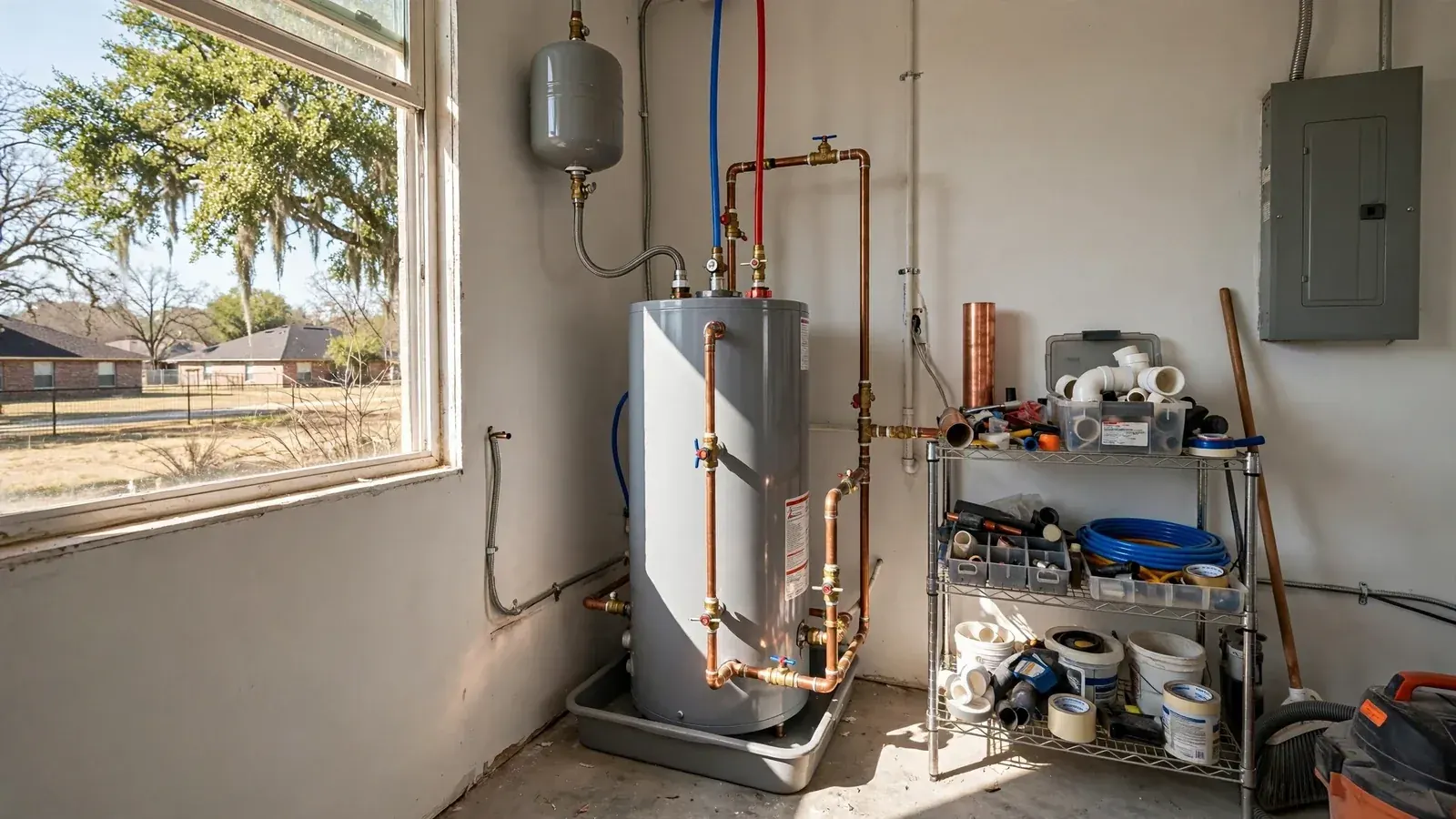
What a correct water heater installation includes
A water heater is more than a tank on a stand. The install is a set of connections and safety devices, and the whole system is only as safe as its weakest piece. Manufacturer manuals list the same core items, so use this list when you read a quote.
- Shutoff and connections. A working cold-water shutoff on the inlet and new connectors or pipe on the hot and cold ports, with dielectric unions or couplings where the tank meets copper.
- Relief valve. A listed temperature and pressure relief valve threaded straight into the tank opening, with no other valve between it and the tank.
- Discharge pipe. A full-size pipe off the relief valve that slopes down and ends within 6 inches of a floor drain or outside the building. It is never capped, plugged, or reduced.
- Expansion control. A thermal expansion tank when the home has a closed water system, which happens when a backflow preventer or check valve sits at the meter.
- Drain pan. A metal pan piped to a drain where a leak could stain a ceiling or ruin a floor.
- Gas work. A gas line with a sediment trap, a soapy-water leak test on every joint, a vent that suits the model, and enough combustion air.
- Fill and purge. A full tank before power or flame, then a hot faucet opened for about 3 minutes to push out air and sediment.
Can you install a water heater yourself?
Some owners can swap a plain electric tank heater, but plenty should not try. A.O. Smith's gas heater manual says that anyone not qualified, and licensed or certified as the local authority requires, should not attempt the procedures in it. Rinnai's tankless manual says a trained professional must install the unit and leak test it, and that improper installation voids the warranty.
| Task | Homeowner? | Why |
|---|---|---|
| Shutting off water and power, draining the old tank | Yes, with care | It needs only the shutoff and a hose to a drain. Tank water can be hot enough to scald. |
| Hauling the old tank out | Yes | The tank is heavy and awkward, so plan on two people and a hand truck. |
| Swapping a same-size electric tank | Maybe | It involves fittings, a new relief valve, and wiring on a dedicated circuit. Check permit rules first. |
| Any gas or power-vent heater | Hire | Gas piping, venting, and combustion air carry fire and carbon monoxide risk. |
| Any tankless unit | Hire | The maker requires gas sizing, special venting, and a leak test by a trained professional. |
| Adding an expansion tank or drain pan | Hire | You need to know whether the system is closed and where the pan can drain. |
Georgia licenses plumbers through the State Division of Master and Journeyman Plumbers. You can look up any plumber by name in the state licensee search before work starts. Do that step even when the quote comes from a company you already know.
Not a good time for a DIY fix? The 24/7 line is open and the price comes first.
Call the 24/7 line (770) 214-4545Tank, tankless, or heat pump, which type fits your home
The US Department of Energy puts the life of a storage tank heater at about 10 to 15 years and a tankless unit at about 20 years. Tankless output tops out around 2 to 5 gallons per minute, so a busy household may need more than one unit. Heat pump models also last about 10 to 15 years.
| Type | Typical life | Main limit | Best fit |
|---|---|---|---|
| Storage tank | About 10 to 15 years | Keeps water hot all day and can run out during heavy use | A straight swap in the same closet or garage spot |
| Tankless | About 20 years | Output of about 2 to 5 gallons per minute, plus venting and gas line changes | Smaller households or homes that want continuous hot water |
| Heat pump | About 10 to 15 years | Needs space that stays between 40 and 90 degrees Fahrenheit and 1,000 cubic feet of air | A garage or basement with open room around the unit |
Ask three questions before you pick. How many fixtures run at once on your busiest morning? Where will the unit sit, and can it vent from there? Does the gas line already reach, and is it sized for the load?
Permits and inspections, ask before you buy
Permit rules vary, so ask Union City Community Development at (770) 515-7920 whether your specific job needs one. A like-for-like swap can be treated differently from a move to a new spot or a change of fuel. Ask before you order the heater, because the answer decides who is allowed to pull the permit.
Also ask what inspection steps follow and what the inspector will want to see. A plumber who works in the city regularly can usually answer both in plain terms. If a quote says nothing about permits, ask the question out loud and write down the reply.
Renting in Union City, who decides on the heater
Census QuickFacts shows that only 40.4 percent of Union City homes are owner-occupied, so roughly six in ten households rent. In a rental, a failed heater usually starts with the tenant and ends with the landlord. Report it in writing, and do not buy or install a replacement without the owner's approval.
The owner picks the type and the contractor. That matters because the city says permits are issued to the certified contractor, so a tenant or handy neighbor cannot simply pull one. If the heater is leaking or you smell gas, call the landlord and the gas utility at once and leave the repair to professionals.
Install day, step by step
- The plumber confirms the model, fuel type, vent path, and shutoff valves before touching anything.
- Power or gas is switched off, the cold supply is closed, and the old tank is drained to a floor drain or outdoors.
- The old heater is disconnected and removed, and the spot is checked for rust, water stains, and a soft floor.
- The new heater is set level, on a pan where needed, and the water lines, relief valve, discharge pipe, and expansion tank go in.
- Gas or electrical connections and venting are completed, and gas joints are tested for leaks.
- The tank is filled, air is purged through a hot faucet, and then power is restored or the burner is lit.
- The plumber checks the vent draft, tests the discharge path, and shows you where the shutoffs are.
A swap that reuses a sound vent and good shutoffs is the simplest case. Moving from a tank to a tankless unit, or running a new vent, adds gas and vent work and makes for a longer job. Our water heater installation service schedules same-day appointments when available, and you can call (770) 214-4545 to talk through your setup.
Warning signs of a poor install
Stop and call a professional if you see any of these
A rotten-egg gas smell, a hiss at a gas joint, or a carbon monoxide alarm. Leave the house, then call 911 or the gas utility from outside.
Water dripping or steaming from the relief valve discharge pipe. Rheem's valve instructions say discharge at the drain outlet points to an abnormal condition in the heater or a defective valve, and a qualified service person should find the cause.
A pool of water under the tank, or a drain pan that keeps filling. Close the cold-water shutoff and call.
Questions to ask before you approve any quote
- Will the vent, gas line, and shutoff valves be reused or replaced, and why?
- Does the quote include a new relief valve and a discharge pipe, and where does the pipe end?
- Is my water system closed, and does it need an expansion tank?
- Who pulls the permit if one is needed, and what inspection follows?
- Is the old heater hauled away, and what does the manufacturer warranty require from the installer?
- Will the full price be clear before work starts?
These questions work the same way for homes in nearby Fairburn and South Fulton, so use them with any contractor you compare. A good answer is specific and names parts. A vague answer is a reason to keep asking.
Which codes apply
Water heater installs are covered by the International Plumbing Code (IPC) and, for gas units, the International Fuel Gas Code (IFGC). Union City's permit page lists both in the 2018 editions with Georgia amendments. Ask Community Development at (770) 515-7920 whether your swap needs a permit.
What water heater installation means in Union City, GA
Union City says permits are required for construction, alteration, and repair, and it issues them to the certified contractor. The city's permit page does not say which permit a water heater swap needs. Call Community Development at (770) 515-7920 before you order a unit, and you will know whether the permit runs through your contractor.
The same page lists the 2018 International Plumbing Code with Georgia Amendments (2020) and the 2018 International Fuel Gas Code with Georgia amendments. A gas water heater involves both plumbing and fuel gas work. Ask your plumber which sections apply to your heater so the quote reflects the rules the inspector will use.
Union City buys its water from the City of Atlanta and runs its own distribution system. The city's 2023 water quality report names chlorine as the disinfectant but does not report hardness. That means the report cannot tell you how fast scale will build inside a heater, so test your tap or call the city water office at (770) 306-6855 before you settle on a type.
Questions homeowners ask
It depends on the heater type and the shape of the existing setup. A like-for-like swap with sound shutoffs and venting is the simplest job. A switch from tank to tankless, or a new vent route, adds steps, so ask the plumber for a plan before work starts.
Permit rules vary by city and by job. Union City says permits are required for construction, alteration, and repair and are issued to the certified contractor. Ask Union City Community Development at (770) 515-7920 about your specific heater.
The Department of Energy says tankless units last about 20 years and storage tanks about 10 to 15. Tankless output is limited to about 2 to 5 gallons per minute, and the install often needs new venting and gas line work. The right choice depends on how many fixtures you run at once.
Georgia licenses master and journeyman plumbers, and city permit rules vary. Manufacturer manuals tell unqualified people not to attempt gas and venting work. Ask the city whether owner-performed work is allowed on your property before you buy parts, and hire a licensed plumber for gas and tankless units.
The Department of Energy says water heaters typically last about 10 to 15 years and advises researching a replacement as yours nears that age. Planning ahead lets you compare types and quotes instead of choosing in a hurry with no hot water.
The city's 2023 water quality report does not publish hardness, so the number is unknown from that source. Rinnai's manual says units in hard-water areas need treated water and may need more frequent flushing. Test your tap, and plan on a flushing schedule if the result is hard.