
Step one, the meter test you can run today
The EPA describes a simple check. Turn off every fixture and appliance, note the meter reading, wait two hours without using water, and read it again. If the number changed at all, water is leaking somewhere after the meter.
Many meters also have a small leak indicator, often a triangle or dial that spins when any flow passes. If it spins with everything off, that is the same signal. Take a photo of the meter face before and after the wait, with the time visible in the shot.
A positive test does not prove the leak is under the slab. It could be a running toilet, an irrigation line, or a pipe in a wall. The next steps narrow it down.
Step two, rule out the easy culprits
- Drop a few drops of food coloring into each toilet tank, wait 10 minutes, and look for color in the bowl, as the EPA suggests. A leaking flapper can spin the meter by itself.
- Check under sinks, behind the washing machine, and around the water heater for drips or damp cabinets.
- Look at outdoor spigots and any irrigation valves, since a stuck valve can run all night.
- Check the water heater's relief valve and drain line for a trickle.
Fixing a toilet flapper takes minutes, and the meter test can then be repeated. If the meter still moves after the easy items are cleared, a hidden pipe is the likely cause.
Not a good time for a DIY fix? The 24/7 line is open and the price comes first.
Call the 24/7 line (770) 214-4545Step three, signs that point at the slab
Slab leaks leave clues on the floor and in the bills. The EPA notes that a family of four using more than 12,000 gallons in a cold month, such as January or February, may have serious leaks. Compare your recent bills against the same months last year.
| What you notice | What it may point to |
|---|---|
| Warm or hot spot on the floor | Leak on a hot supply line under the concrete |
| Sound of running water with everything off | Pressurized leak, often on the main or a branch line |
| Damp carpet edge or lifting baseboard | Water traveling along the slab to the nearest wall |
| Bill rises with no change in habits | Continuous leak that runs day and night |
| Low pressure at several fixtures | Large leak, or a failing main supply line |
| Musty smell near the slab edge | Long-running moisture that needs a closer look |
None of these proves a slab leak on its own. Together with a moving meter, they justify calling a plumber to confirm it.
Step four, isolating the leak with a pressure test
A plumber shuts the main valve at the house and watches whether the pressure holds. If it drops, the leak is inside the home. If the meter still moves with the house valve closed, the leak is between the meter and the house, which is the service line.
Next, the plumber isolates the hot side and the cold side. Closing the water heater's cold inlet and the cold main on separate tests shows which system is losing pressure. This matters because hot lines are the ones that make warm spots on the floor.
Plumbers may add test caps to individual branch lines, so a leak is narrowed to one run of pipe before any tool touches the floor. A good tester writes down each gauge reading and the time, which gives you a record for later.
Step five, listening for the leak
Electronic listening devices pick up the sound a pressurized leak makes. A sensitive microphone or geophone is moved along the floor in a grid, and the signal gets stronger the closer it gets to the leak. Ground geophones work because a pressurized leak makes a faint noise that is muffled on its way up, so the strongest reading sits directly above the leak.
Pipes, hard flooring, and nearby appliances can all add noise, so a plumber confirms the reading from several directions. A correlator, which uses two sensors on the pipe to time the sound, can help on exposed lines. It works best with some pipe access.
Running water in a nearby drain or a loud compressor can mask the leak. Plumbers often ask you to turn off HVAC and appliances for the test.
Step six, thermal imaging and tracer gas
Thermal imaging maps surface temperature. A hot water leak warms the concrete above it, and an infrared camera shows that difference even when your hand cannot feel it. Thermographic surveys are a recognized way to find subsurface leaks by mapping temperature differences. Cold leaks are harder to see this way.
Tracer gas testing fills the isolated line with a gas, and a sensitive detector sniffs for it at the surface. Helium and hydrogen are both used as tracer gases in leak testing. This method is not always needed, and not every plumbing company offers it. It helps when listening is unclear, for example in a noisy house.
| Method | What it finds | Main limit |
|---|---|---|
| Meter and pressure test | Whether and where in the system water is lost | Does not show the exact spot |
| Electronic listening | The sound of a pressurized leak | Background noise can mask it |
| Thermal imaging | Heat from a hot water leak | Weak for cold lines |
| Tracer gas | Gas escaping at the surface | Not offered by every company |
A competent plumber uses more than one method and cross-checks the result. A single tool can mislead, but two or three that agree rarely do.
Step seven, after the spot is found
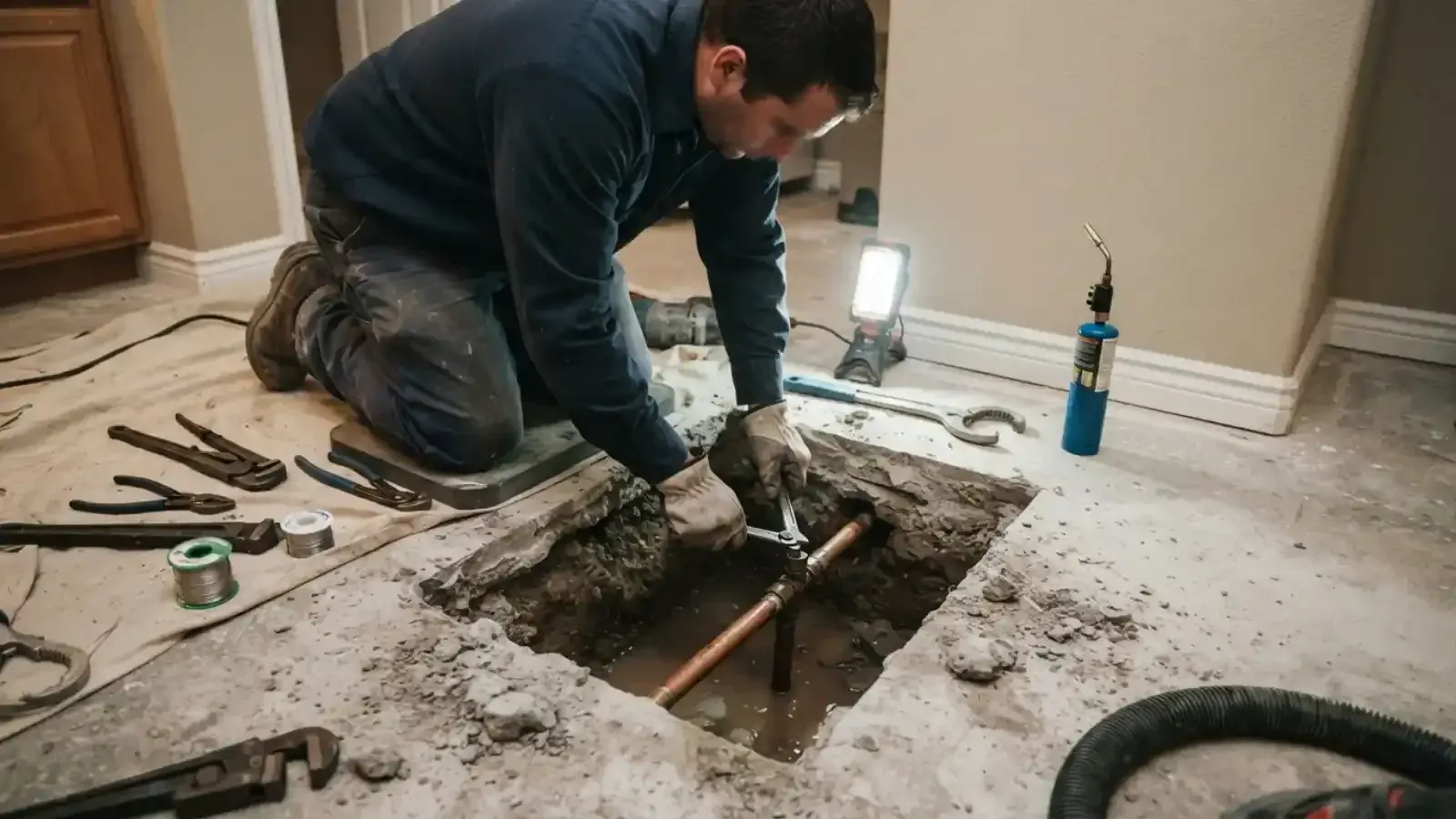
Once the leak is located, you have choices. A small access cut can allow a spot repair, an overhead reroute can bypass the buried line, or the line can be replaced in place. Our guide to slab leak repair explains how those options compare.
If the exact location is still unclear after a slab test, a separate hidden leak detection visit can check other likely spots, such as wall lines, crawlspace sections, and the yard service line.
Neither step has to wait until you are sure. Call at (770) 214-4545 if the meter keeps moving or water is showing up on the floor.
What to document for insurance
Insurance rules differ, so ask your insurer how it treats slab leaks and what proof it wants. Policies often treat sudden, accidental damage differently from slow, ongoing seepage, so a record that shows when you first noticed the problem helps.
- Photos of the meter before and after the two-hour test, with the time visible.
- Recent water bills, and the same months from last year for comparison.
- Photos and short videos of any damp spots, warped flooring, or damaged belongings.
- The plumber's written report with the test results and the exact location found.
- Receipts for emergency steps, such as extra fans, water shutoff, or temporary lodging.
- Notes on the dates you noticed each sign, and the date you called for help.
Do not throw away damaged materials until the insurer has seen or approved the photos. Renters should send the same records to the landlord or property manager in writing.
What not to do while you wait
Do not break the concrete yourself to look for the pipe. A cut in the wrong spot can hit a second line or an electrical conduit. Do not run a pressure washer or heavy tool on a floor you suspect is wet.
If the leak is large or the floor is warm, shut off the main valve and call. If it is small, shut off the main when no one needs water, such as overnight. This limits damage while you wait. In nearby places such as College Park or Fairburn, the same sequence of tests applies, though each has its own water utility.
Detection and permits
Plumbing under a slab is covered by the International Plumbing Code (IPC). Detection only looks for the leak. The repair that follows, whether spot repair or reroute, may need a permit, so ask Union City Community Development at (770) 515-7920.
Checking the meter and the city line in Union City, GA
Union City buys water from the City of Atlanta and owns and maintains its own distribution system of about 112 miles of water line. If your meter test shows a leak and the plumber's isolation test points to the pipe between the meter and the street, that line may be the city's responsibility. Call the city water office at (770) 306-6855 and ask who owns that stretch before paying for a repair.
If any repair needs digging in a yard to reach a service line, call 811 first. Georgia 811 is a free service for locating buried utilities. Permit rules vary by job, so ask Union City Community Development at (770) 515-7920 whether the repair needs one.
Questions homeowners ask
They start with a meter test, then isolate lines with a pressure test, then use electronic listening and sometimes thermal imaging to find the spot. Tracer gas is an option when sound is unclear. The goal is to open as little concrete as possible.
You can confirm that a leak exists. The two-hour meter test and the toilet dye test need no tools. Pinpointing the leak under concrete does need a plumber with proper equipment.
Not always. A warm spot can also come from a heating duct or sunlight through a window. A warm patch that appears with a moving meter points to a hot water leak.
That is the service line. Call a plumber to confirm the location, and call the city water office at (770) 306-6855 to ask who is responsible for each section of the line. Call 811 before any digging.
The tests are noninvasive. Listening devices, pressure gauges, and thermal cameras sit on or above the floor. Concrete is only cut after the leak is located and you approve a repair.
Call (770) 214-4545 for a licensed plumber who can run the isolation test. The city water office at (770) 306-6855 can check the meter and the street side of the line. Keep your meter photos and bills for the plumber and your insurer.