
What a jetting quote is actually paying for
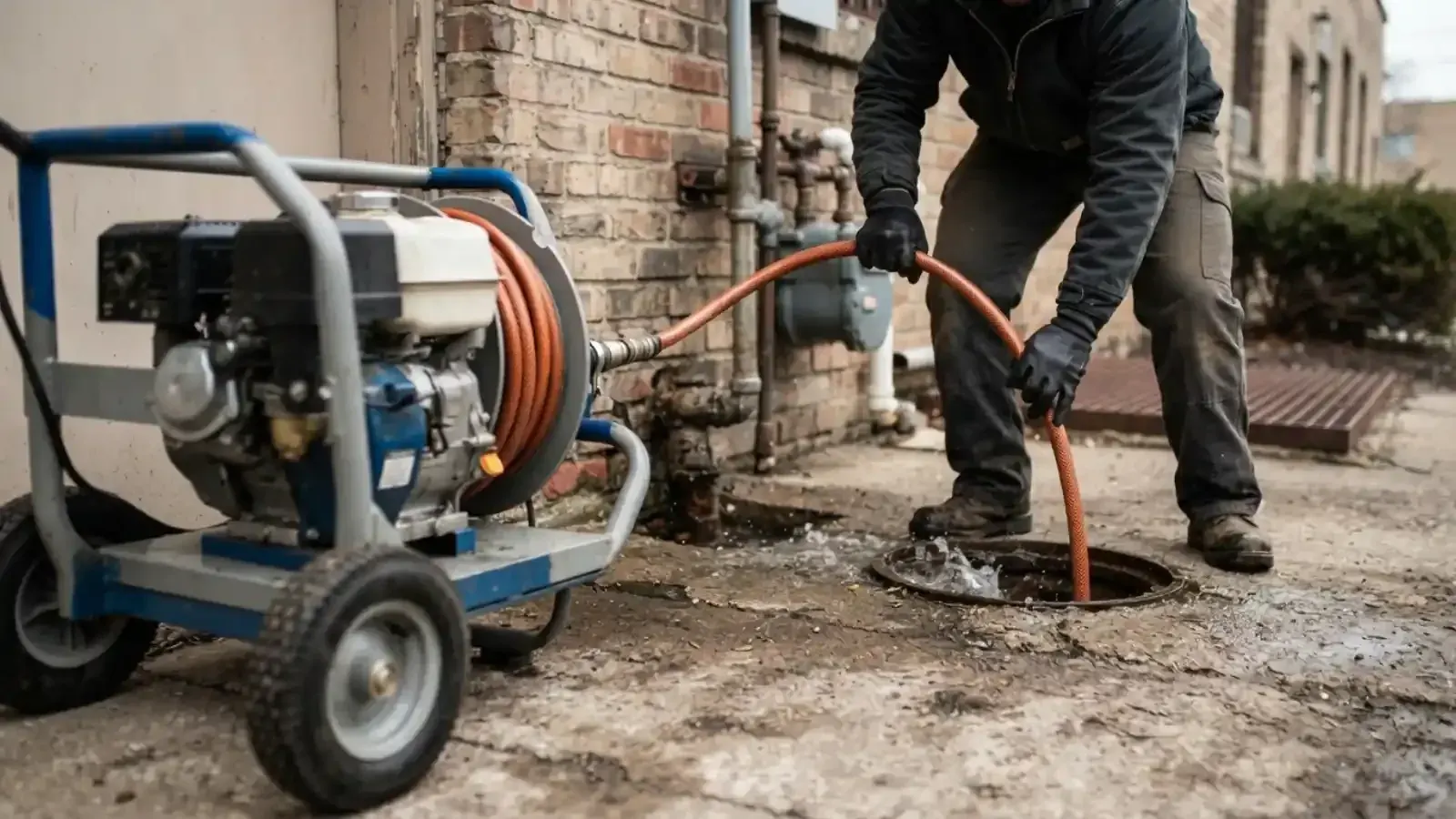
Hydro jetting pushes a hose with a special nozzle down your main sewer line. The nozzle fires pressurized water backward and sideways, which scours the pipe wall and pulls the hose forward. Grease, roots, paper and scale get cut loose and flushed toward the city sewer.
That sounds simple, yet the work is billed in pieces. A quote usually bundles setup at the cleanout, time spent running the hose, a trip or two with a camera, and the cost of bringing a jetting trailer or truck to your property. A single flat figure hides those pieces, and the hidden pieces are where quotes drift apart.
Cost also tracks risk. Jetting an intact, well-sloped PVC line is routine. Jetting a cracked clay or cast iron line without looking first can make a small defect worse. A good quote therefore includes a look inside the pipe, not just a blast of water.
Cleanout access changes the whole job
The single biggest swing factor is where the hose enters the pipe. A properly installed two-way cleanout in the yard lets a crew set up in minutes. A line with no outside cleanout may require pulling a toilet, or opening the line from the roof vent or a basement trap, and that adds labor and risk.
On many houses the usual entry point is a capped pipe in the yard or beside the foundation. If your cleanout is buried under sod or mulch, finding and digging it up is extra time. Call 811 first if the plan involves any digging. Georgia 811 notifies utilities so crews do not hit buried lines.
Quick check before you call
Walk the outside of your house and look for a capped pipe, about three to four inches wide, near the foundation or in the yard between the house and the street. Take a photo of it.
Tell the dispatcher whether you found a cleanout, because a visible one often means a faster, cheaper setup than a line that must be entered through a fixture.
Not a good time for a DIY fix? The 24/7 line is open and the price comes first.
Call the 24/7 line (770) 214-4545Length and diameter of the line
Longer lines take more hose, more water and more time. A short lateral from a ranch house to the street is a different job than a long run from a house set far back on a lot. Ask the crew whether the quote assumes the full distance to the city connection.
Diameter matters too. Most residential laterals are four or six inches, and larger pipes need a different nozzle and more flow to clean properly. A main that steps down or has offsets can slow the hose and raise the time on site.
Be honest about what you know. Many owners do not know their line length, and tenants almost never do. The camera pass is how a crew learns the real length, so a first-visit quote is often an estimate that firms up once the camera is down the pipe.
Roots, grease or scale decide the method and the time
What is inside the pipe sets the nozzle, the number of passes and the time. A soft grease buildup can clear in one or two passes. A dense root mass or hardened scale takes several passes and sometimes a cutting step before the jet.
| Blockage | What it looks like | What it does to the quote |
|---|---|---|
| Grease and soap buildup | Slow drains in many fixtures, a sour smell from the kitchen line | Often fewer passes, so jetting time stays moderate |
| Tree roots | Repeat backups, roots visible on camera at joints | More passes and sometimes a cutting step first, so time goes up |
| Wipes and paper wads | Sudden backup, often after a flush | Usually quick to clear, but the camera should confirm nothing else is wrong |
| Mineral scale or old buildup | Gradual narrowing, common in older metal lines | Longer work, and the pipe wall must be strong enough to survive it |
| Collapsed or offset pipe | Cleaning clears the line briefly and it backs up again | Jetting alone will not fix it, so the real cost shifts to repair |
Red clay is common across the Georgia Piedmont, and roots follow moisture toward sewer joints in any soil. If a line has backed up more than once in a year, roots at a joint are a likely suspect. That is a reason to ask for a camera report before agreeing to repeated cleanings.
Why the camera before and after matters to the price
A sewer camera is a small waterproof lens on a flexible rod, fed through the cleanout. It shows pipe material, sags, cracks, roots and the location of problems, often with a depth and distance readout. You can read more about that service on the sewer camera inspection page.
A before video tells the crew what nozzle and approach to use and whether jetting is safe at all. An after video proves the line is actually clear, which a flowing drain alone does not. Ask for both, and ask whether you get the recording or only a verbal summary.
Camera work is sometimes a separate line item and sometimes bundled. Neither is wrong, but you should know which. A quote that leaves the camera out may look cheaper, then grow once the crew needs to see the pipe.
Jetting versus cabling versus lining
These three get compared because they all deal with a bad sewer line, but they solve different problems. Cabling punches a hole through a clog. Jetting washes the pipe wall clean. Lining rebuilds a damaged pipe from the inside. Choosing the wrong one wastes money.
| Method | Best for | Limits | Cost drivers |
|---|---|---|---|
| Cabling (auger) | A single clog or a soft stoppage | Leaves grease on the pipe wall, so clogs often return | Cable length, access, time on site |
| Hydro jetting | Grease, roots, scale and recurring clogs | Not for pipes with serious breaks or collapses | Access, pipe size, number of passes, camera work |
| Pipe lining | Cracked or root-invaded pipe that is otherwise in line | Needs the pipe cleaned first, and a collapsed section may rule it out | Pipe length, diameter, prep cleaning, cure time |
Jetting often runs before lining because resin will not bond to a dirty wall. That means a lining quote can include a jetting line inside it. If you are comparing bids, make sure each one says whether cleaning is included.
For a plain stoppage, the main sewer line cleaning service may be all you need. For recurring buildup or roots, hydro jetting is the more thorough choice. A camera result should drive the decision, not the sales pitch.
Truck access, site conditions and after-hours work
Jetting equipment is heavy and needs a place to park and a path to the cleanout. A narrow driveway, a gated yard, a steep slope or a cleanout behind a fence all add setup time. Tell the dispatcher about gates, dogs and parking before the crew arrives.
Water supply matters as well, because a jetter needs a steady source, either its own tank or your outdoor spigot. Ask the dispatcher which one the crew expects, so a broken hose bib does not stall the job. Wastewater must also go somewhere safe, so a crew will want a clear flow path to the city sewer.
Timing affects price. Night, weekend and holiday calls are priced for the extra staffing, and that is normal for any emergency trade. If the backup is slow and no sewage is entering the house, a scheduled daytime visit may cost less. If sewage is coming up a floor drain or tub, do not wait, and stop using water in the house.
How to read a quote line by line
A clear quote names the service, the access point, what is included and what could change the price. Ask for it before work starts. Our standard is a clear price before work starts, and you should expect the same from anyone you hire.
- Check the access point. The quote should say cleanout, fixture entry or roof vent, and whether digging is involved.
- Look for the pipe details. Length, diameter and material should be stated or marked as an estimate to be confirmed by camera.
- Confirm the camera. See whether a before video, an after video or both are included, and whether you receive the files.
- Read the exclusions. Roots that regrow, collapsed sections, and a second visit for repairs are usually separate.
- Ask about the follow-up. If the line backs up again within days, find out whether a return visit is covered.
- Ask about permits. Permit rules vary, so ask Union City Community Development at (770) 515-7920 if the work could involve a repair.
Be wary of any quote that promises to fix a recurring backup without ever looking inside the pipe. A cheap jetting price on a collapsed line is just a delay. Having the camera result in hand also helps if a landlord or insurer has to approve the work. Neighbors in Fairburn and South Fulton ask the same quote questions, and the same checklist applies there.
Renters, landlords and who pays
Roughly six in ten Union City households rent. If you rent and the main sewer line backs up, the line itself is usually the owner's responsibility, so call the landlord first and document what happened with photos. If a tenant caused the clog, the lease may say otherwise.
Owners should keep any camera video. A before and after record shows what condition the pipe was in, and it helps when you compare future quotes or file an insurance question. Insurance often treats sudden damage and slow wear differently, so ask your insurer how your policy handles sewer backup.
What this means for sewer work in Union City, GA
The City of Union City owns and maintains its own sewer collection system, about 91 miles of sewer, according to the city's Water and Sewer Division. The private lateral from your house to the city connection is generally the owner's side, so ask the crew where your line meets the city main. That boundary tells you whether a problem is yours to fix or the city's to handle.
If a backup affects the whole street or a manhole is overflowing, that points to the city system. The Water and Sewer Division at (770) 306-6855 takes reports during business hours, and the city lists an after-hours line at the same number, extension 1, for urgent utility emergencies. A quick call can save you paying a plumber for a problem that sits in the public main.
The city also runs a Fats, Oils and Grease program page for residents. Grease is a leading cause of sewer buildup everywhere, so pouring cooking fat down the sink works against both your line and the city's. If your quote blames grease, ask the crew to show it on camera.
Union City's permit page says permits are required for construction, alteration and repair, and it lists the 2018 International Plumbing Code with Georgia amendments. Permit rules vary, so ask Union City Community Development at (770) 515-7920 before a repair that opens the ground or replaces pipe.
Questions homeowners ask
It depends on access, pipe length and diameter, the type of blockage, camera work, truck access and timing. Because those vary from house to house, a responsible company gives a clear price after learning your cleanout location and line condition. Call (770) 214-4545 and have photos of your cleanout ready.
Jetting cleans the whole pipe wall, while a cable mostly opens a path through the clog. For a one-time stoppage, a cable may be enough. For grease, roots or repeat backups, jetting usually lasts longer, as long as the pipe is sound.
It can if the pipe is already cracked, collapsed or badly corroded. That is why a camera look comes first. If the camera shows serious damage, repair or lining is the better path than more water pressure.
There is no fixed schedule. A line with a one-time wipe clog may never need it again, while a line with roots may need attention on a regular cycle. The after video and the cause of the clog help decide the interval.
A cleanout makes the job faster and safer. Without one, a crew must enter through a toilet, a roof vent or another opening, which adds work. Adding one during the visit makes future service easier.
Check whether neighbors have the same problem or a manhole is overflowing. If so, call the city Water and Sewer Division at (770) 306-6855. If the backup is only in your house, the blockage is probably in your private line, and a plumber at (770) 214-4545 can run a camera to find it.