
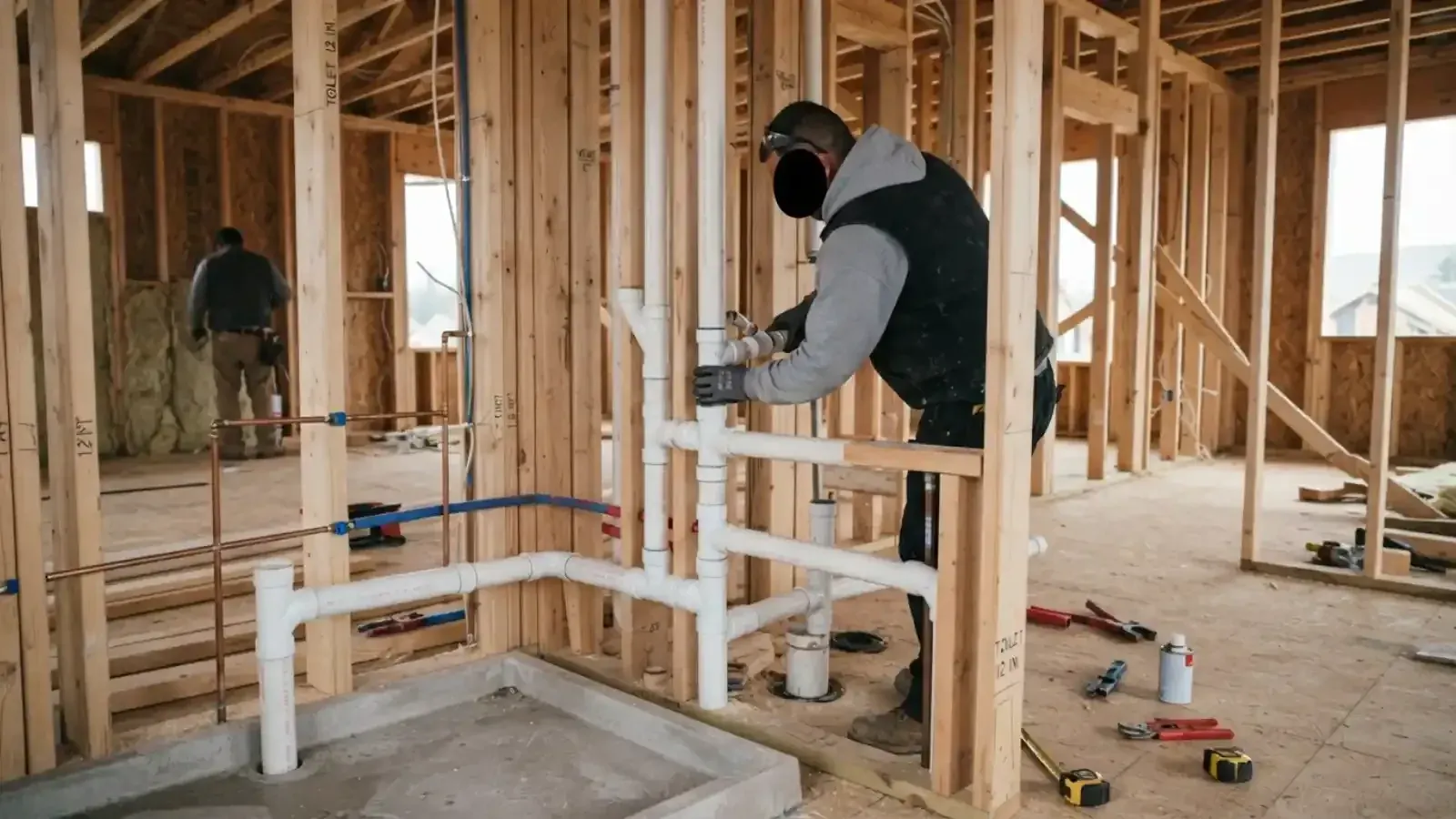
The drain layout in plain terms
Start at the basins. Each strainer sits in the sink opening and screws to a tailpiece, which is a short vertical pipe. A horizontal waste arm then leaves each tailpiece and runs toward the middle of the sink cabinet.
The two arms meet at a tee fitting, directly over a single P-trap. The trap is the U-shaped bend that holds water and blocks sewer gas. From the trap, a trap arm runs through the wall and connects to the building drain.
A continuous waste is the horizontal pipe that joins the two tailpieces before they reach the trap. It does the same job as two arms and a tee, with fewer joints. Whichever style you choose, only one trap is needed, since one trap serves the pair of basins.
| Part | What it does | Common mistake |
|---|---|---|
| Strainer and tailpiece | Catches debris and drops water into the drain | Skipping plumber's putty or over-tightening the nut |
| Waste arm or continuous waste | Carries water sideways from each basin to the tee | Running it flat or uphill instead of with a downward slope |
| Tee or wye fitting | Joins both basins to one outlet | Pointing the fitting the wrong way |
| P-trap | Holds a water seal against sewer gas | Installing a second trap in series |
| Trap arm and vent | Connects the trap to the drain and lets air in | Leaving the trap with no vent |
Choose the right fitting and set the slope
Sources do not fully agree on the fitting. One how-to guide says to use a sanitary tee with its sweeps pointing toward the trap. Another warns that a sanitary tee is a common mistake when joining two sinks and says a long-sweep double wye is the correct part. The code your inspector uses and the sink manufacturer's instructions should settle it.
Slope matters more than most people expect. Each horizontal arm should slope toward the trap by at least 1/4 inch per foot. Too little slope leaves water and debris standing in the pipe. Check each arm with a small level before you tighten anything.
When one basin holds a disposal, the drain heights no longer match. A disposal sets the height of its own outlet, so you add a vertical tailpiece to the other basin to bring its horizontal arm to the same level. Dry fit every piece before you glue or tighten.
Not a good time for a DIY fix? The 24/7 line is open and the price comes first.
Call the 24/7 line (770) 214-4545Why the vent matters and what it does
Water moving through a drain pushes air ahead of it and pulls a vacuum behind it. A vent supplies air to the system so that flow stays smooth. Without it, that vacuum can siphon a trap dry, which lets sewer gas into the room.
Toilet traps have the shortest water seal and are the most vulnerable to siphoning, but any trap can be emptied. A kitchen sink with a gurgling drain, a slow flow, or a sewer smell often has a venting problem rather than a clog. A snake will not fix that.
An air admittance valve is a one-way valve that opens when a vacuum forms. The International Plumbing Code and the International Residential Code allow it in place of a roof vent in some cases, but some jurisdictions prohibit it. Ask Union City Community Development which method it accepts before you buy one.
Connecting a garbage disposal and a dishwasher
Mount the disposal before you set the trap. The unit attaches under one basin, and its discharge outlet runs horizontally toward the tee. You do not need an elbow on that basin, because the disposal replaces it. Extend the outlet with straight pipe and match the height on the other basin.
A dishwasher drain hose connects to a port on the disposal or to a tee with a dishwasher port on the tailpiece. If the disposal is new, you must knock out the plug inside the dishwasher inlet before you mount the unit, or the dishwasher will not drain. Do the knockout first, and fish the plug out of the chamber.
Secure the dishwasher hose with a clamp. Hand-tighten each slip nut, run water in both basins, and check every joint for drips. If you want help with the unit itself, garbage disposal repair and replacement covers mounting, wiring, and leaks.
Ask before you cut
Trap placement, trap arm length, and vent rules come from the plumbing code your inspector uses, and the numbers differ by edition. Confirm them with Union City Community Development before you buy pipe, instead of copying a video.
Step-by-step order of work
- Shut off the water and place a bucket under the sink. Remove the old traps, arms, and strainer nuts.
- Set each strainer in plumber's putty, tighten the nut from below, and attach the tailpiece or disposal.
- Mount the disposal first if one is going in, and knock out the dishwasher plug.
- Dry fit the arms, tee, and trap and mark the cuts so the junction sits directly over the trap opening.
- Cut with a hacksaw, deburr the edges, and slope each arm at least 1/4 inch per foot.
- Hand-tighten the slip nuts, connect the trap arm to the wall stub, and attach the dishwasher hose.
- Fill both basins, pull both stoppers at once, and look for leaks and gurgling.
The last step hides problems when it is skipped. Filling both basins and draining them together tests the flow the way daily use will, and slow draining shows up fast.
Common mistakes that cause leaks and slow drains
- Installing two traps in series. One trap is enough for a double sink, so a second adds joints and leak points for no benefit.
- Using the wrong fitting where the two basins join, which can send water backward into the other basin.
- Flat or backward slope, which leaves standing water in the arm.
- Missing or blocked vent, which causes gurgling and can empty the trap.
- Overtightening plastic slip nuts. Hand tight is usually enough, and locking pliers can finish a leaking joint.
- Forgetting the dishwasher knockout plug, which backs dishwasher water into the sink.
- Skipping the leak test with both basins full.
When a licensed plumber and a permit matter
Georgia licenses plumbers through the State Division of Master and Journeyman Plumbers under the Secretary of State. The state says a person may not legally perform covered services until they hold an active license, and the classes are Journeyman, Restricted Master, and Non-Restricted Master. You can check any plumber by name in the state's licensee search at goals.sos.ga.gov.
Union City says permits are required for construction, alteration, and repair, and they are issued to the certified contractor. The city lists the 2018 International Plumbing Code with Georgia Amendments (2020) and the International Fuel Gas Code 2018. Permit rules vary, so ask Union City Community Development at (770) 515-7920 before you start.
A new double sink in a remodel, a moved drain, or a new vent are the kinds of jobs where a plumber and the permit office should be involved. Plumbing installation covers fixtures, drain changes, and rough-in work, and a plumber can pull the permit and arrange the inspection. For a simple swap of an existing fitting, the city office can tell you whether a permit applies.
Renters and hiring help
If you rent, do not alter drain plumbing without your landlord's written approval. A leak under a sink can damage the cabinet and the unit below, and the lease may assign that cost to you. Ask the property manager to arrange the work.
The same dispatch line serves homes in Palmetto and Fairburn. Call (770) 214-4545 for a same-day appointment when available, or for the 24/7 emergency line if a sink leak is flooding the cabinet.
Code for the drain layout
A double sink drain is built to the International Plumbing Code (IPC), including the trap and the vent that keeps it from siphoning dry. If your layout differs from the diagram above, such as a long horizontal run, ask a licensed plumber before gluing anything.
What this means in Union City, GA
Union City's Community Development One Stop Shop handles permits and can be reached at (770) 515-7920. The city's permit page says permits are required for construction, alteration, and repair and are issued to the certified contractor. If your sink project moves a drain, ask the office before you buy parts, since a permit changes who may do the work.
The city lists the 2018 International Plumbing Code with Georgia Amendments (2020). That edition is the reference the inspector will use, so ask for the relevant sections before you plan the vent and trap. Do not rely on a video for code numbers, because each state and city adopts its own edition.
About 60 percent of Union City households rent, with an owner-occupied rate of 40.4 percent in Census QuickFacts. That means many double sinks are in rentals, where the landlord controls plumbing changes. Get approval in writing and confirm who pulls the permit.
Questions homeowners ask
One. A double sink uses a tee or continuous waste to join both basins to a single P-trap, and a second trap in series is not needed.
Guides disagree. Some use a sanitary tee with the sweeps pointing toward the trap, while others call for a long-sweep double wye. Follow the sink maker's instructions and your local inspector's requirement.
Two Hunker how-to guides say to slope the horizontal drain arms at least 1/4 inch per foot toward the trap. A small level on each arm confirms it before you tighten the nuts.
Yes. A vent lets air into the system so water does not siphon the trap dry and let sewer gas in. Gurgling, slow drainage, or a sewer smell at a sink often points to a venting problem.
Mount the disposal first and knock out the dishwasher plug in its inlet. Connect the dishwasher hose to the disposal port or a tee with a dishwasher port, and match the drain heights on both basins.
Union City says permits are required for construction, alteration, and repair and are issued to the certified contractor. Permit rules vary, so call Union City Community Development at (770) 515-7920. A licensed plumber can check the rules with the city for your project.