
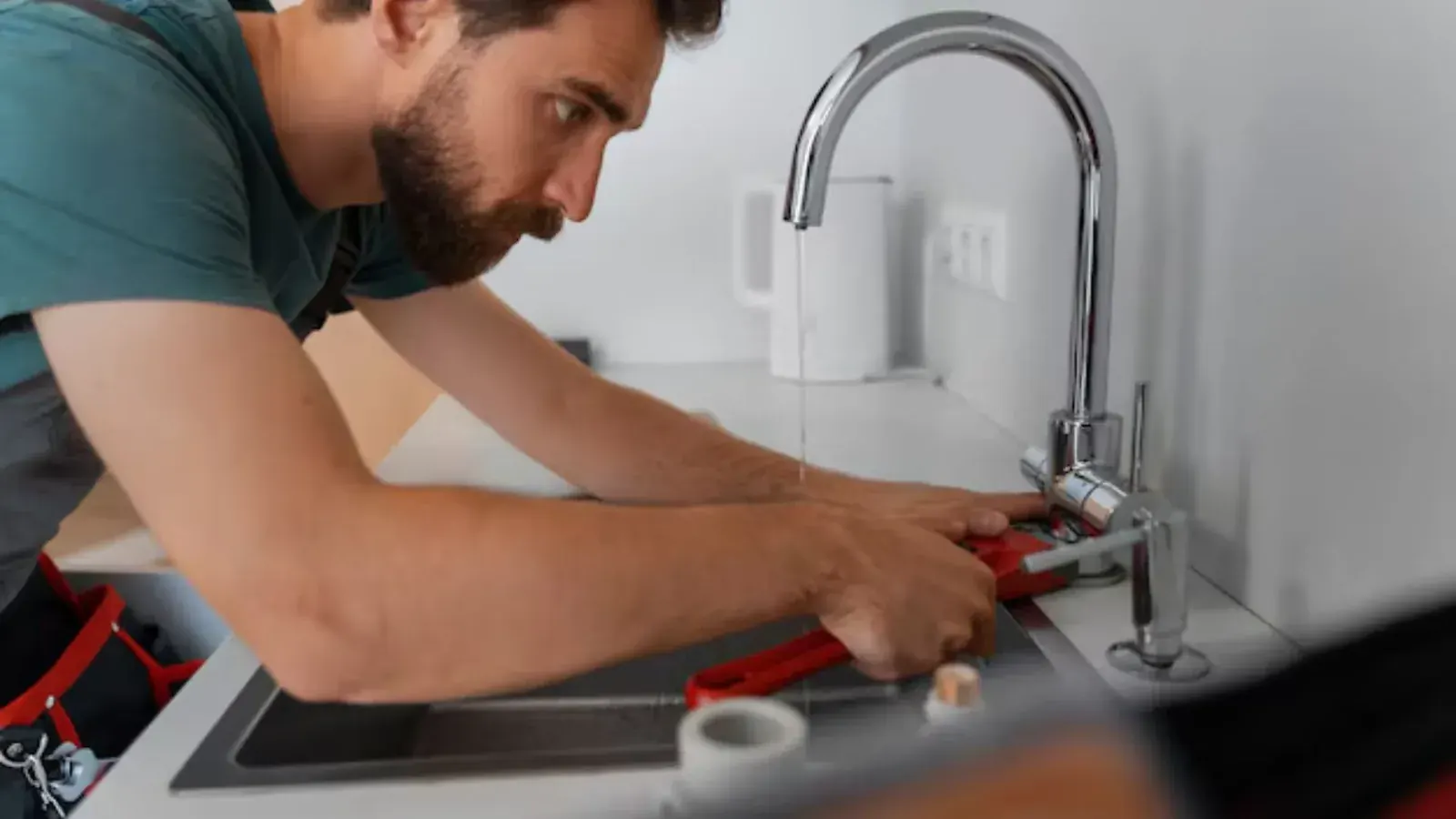
Why a faucet spits and sputters
Pipes that carry water under pressure hold no air when they are full. Air gets in when the water stops, when a section is drained, or when a repair opens the line. When service returns, the air rides ahead of the water and comes out of the highest or farthest faucet in bursts.
| Cause | Pattern you notice | First move |
|---|---|---|
| Water shutoff or main work on the street | Cold and hot faucets spit right after service returns, often upstairs first | Run cold water from a tub or outdoor spigot until steady |
| Water heater drained or replaced | Hot side only spits | Confirm the tank is full, then run a hot faucet until steady |
| Plumbing repair inside the house | Fixtures near the repair spit | Open the lowest and highest faucets one at a time |
| Clogged aerator or screen | One faucet, weak or split stream | Unscrew and rinse the aerator |
| Worn stop valve or supply line | One fixture, may be paired with a drip | Replace the part |
| Leak or pressure loss on the supply line | Whole house, keeps returning, may come with low pressure or a high bill | Test for a leak and call a plumber |
How to bleed air out of your water lines
Both Denver Water and the City of Bellevue give the same core advice for homes after an outage. Run cold water to push air and debris out of the interior plumbing and service line. A bathtub, an upstairs faucet, or an outdoor spigot works best because they pass the most water.
- Close every faucet and make sure no fixture is set to hot yet.
- Open the cold tap in a bathtub or an outdoor spigot slowly and let it run until the flow is smooth and steady.
- Open the cold taps at the other fixtures one at a time, starting with the lowest floor and ending with the highest.
- Flush each toilet once, then run the washing machine's cold tap briefly.
- Run each hot tap until it is steady. If you have just had work on the heater, the tank must be full first.
- Pull the aerators and rinse out any grit, then check that nothing is dripping.
Bellevue advises waiting up to 15 minutes. If air is still coming out after that, treat the problem as more than a post-outage burp. Denver Water also suggests turning off ice makers, washers, dishwashers, and filtration systems before a planned shutoff, since air and grit can reach those parts first.
Not a good time for a DIY fix? The 24/7 line is open and the price comes first.
Call the 24/7 line (770) 214-4545When only the hot side sputters
If cold water runs smoothly and hot water spits, look at the water heater. A.O. Smith's installation manual tells installers to fill the tank completely and open the nearest hot faucet for about 3 minutes to purge air and sediment before the power goes on. A heater that was drained, serviced, or turned on before it was full can send air through the hot lines.
The City of Bellevue adds a warning for people returning from an outage. Do not turn on hot water first, because draining the tank could expose heating elements and damage the water heater. Run cold water until the lines are full, and then open the hot taps.
Steam or crackling noises from the hot side are a different problem. Treat them as a safety issue and have a plumber look at the heater before you keep using it.
Cloudy or rusty water along with the air
Denver Water says air and mineral buildup can enter a service line after a shutoff and make water cloudy or discolored, and that the condition is not harmful and clears when you run cold water at full flow. Bellevue notes that homes with older galvanized iron piping may see rust-colored water after a main shutdown, which usually clears after a minute or two of running.
If the water is still discolored after 15 minutes, call the utility or a plumber. Do the laundry later, since rusty water can stain clothing. Keep the dishwasher and washer off until the water runs clear.
Signs that sputtering means a leak or a pressure problem
- The sputtering keeps coming back days after any outage or repair.
- Pressure is low at every fixture, not just one.
- Your water bill jumps with no change in how you use water.
- The meter keeps moving when every fixture and appliance is off.
- You hear hissing in a wall or see a damp patch on a ceiling, a wall, or the lawn near the meter.
Any of these deserves a real test, not another round of flushing. A plumber can run pressure checks and use listening equipment to find a hidden leak, and our leak detection service covers that work. If the trouble sits on the line between the meter and the house, a water line repair may be the fix.
Is it your house or the street
Ask a neighbor. If two or three homes on your block see sputtering at the same time, the cause is almost certainly on the utility side of the meter. The Union City water office is the right call for that case, and the number is in the local section below.
If only your home is affected, the cause is on your side of the meter. That puts the fix on you or your landlord. Renters should report it to the owner in writing, because roughly six in ten Union City households rent and the owner decides who does the work. For an urgent problem or an active leak, call (770) 214-4545 for a plumber.
Smart habits after any planned shutoff
- Turn off the ice maker, dishwasher, washer, and any water filter before the shutoff, as Denver Water advises.
- Keep the hot taps closed until cold water runs steady, so the tank is not drained and its heating elements stay covered.
- Open cold taps slowly after service returns so the surge does not rattle fixtures or whip air through the line.
- Rinse the aerators on every faucet once the water clears.
- Note the date and time of any outage, because it helps a plumber if trouble returns.
Neighbors in Fairburn and South Fulton follow the same routine, since the steps depend on how pipes fill and not on the town. If the routine does not settle things, bring in a plumber early.
Code reference
Water supply systems are built to the International Plumbing Code (IPC), the base of Georgia's state plumbing code. Sputtering faucets are usually a maintenance problem and not a code one. If the noise started after work on your street, ask Union City Public Services at (770) 306-6855.
What air in the lines means in Union City, GA
Union City buys its water from the City of Atlanta through ten master meters and owns and maintains its own distribution system, which includes 112 miles of water line. Work anywhere on that system can interrupt or disturb flow at your tap. If your neighbors see the same sputtering, call the city water office at (770) 306-6855, because the fix is on the street side of your meter.
The city's 2023 water quality report also advises flushing a tap for 30 seconds to 2 minutes after hours of no use if you are concerned about lead. That same habit clears standing water and some trapped air from the line. Use it first thing in the morning and after a trip, and you will spot a real pressure problem sooner.
Questions homeowners ask
Air in the lines is not harmful to drink. Denver Water says cloudy water caused by air is not harmful and is easy to flush. The risks are splashing hot water from a sudden burst and a pressure problem that the air may be hiding.
Denver Water says air bursts clear after about a minute of running the water. Bellevue advises running cold taps for a few minutes and calling the utility if air remains after 15 minutes.
Look at the water heater first. A heater drained for service, or switched on before the tank was full, can send air through the hot lines. A.O. Smith's manual calls for a full tank and about 3 minutes of hot water running before power is restored.
Yes, a leak or a drop in line pressure can cause spitting. Look for low pressure at every tap, a moving meter with everything off, or a higher bill. Those signs call for a leak test instead of more flushing.
Yes. Fill the tank first, then open a hot faucet and let it run until the stream is smooth. A.O. Smith's manual gives about 3 minutes as the purge time for that step.
Call the Union City water office at (770) 306-6855, which is the number listed in the city's water quality report. When the trouble is on your side of the meter, a licensed plumber handles it.