
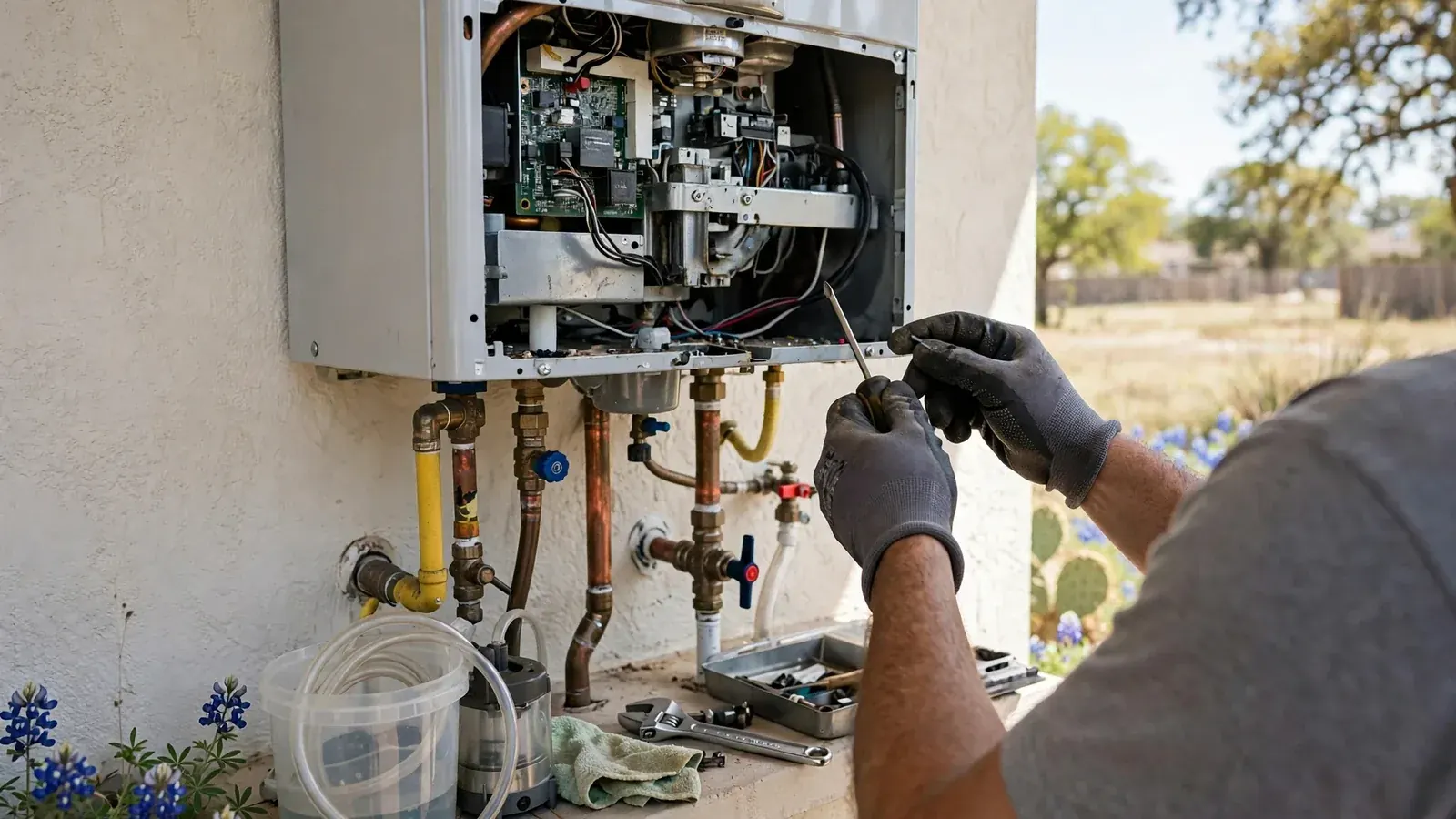
What a relief valve does on a tankless unit
A relief valve is the last line of defense when pressure builds in the hot water side. Rheem's valve instructions say the purpose is to help protect against excessive pressure and temperature, and that the valve opens and discharges water if either condition develops. It is a spring-loaded safety part, not a control, so it should stay closed until something goes wrong.
Tankless heaters hold very little water compared with a tank, but the plumbing around them still holds pressure. Heated water expands, and it has nowhere to go if the system is sealed. The valve gives that pressure a safe exit instead of letting it stress the heat exchanger and the pipes.
Pressure-only valve or combination T&P valve
| Valve | What triggers it | What to know |
|---|---|---|
| Pressure relief valve | Excess pressure | Supplied with Rinnai units and required by ANSI Z21.10.3 per Rinnai's manual. Rated up to 150 psi and at least the heater's maximum Btu per hour. |
| Combination temperature and pressure (T&P) valve | Excess pressure or high temperature | Rinnai says the standard does not require it on its unit, but local codes may. Ask the city if yours does. |
| Tank-style T&P valve placement | Temperature sensor sits in the upper 6 inches of a tank | A tankless unit has no tank, so follow the manual for where its valve connects. |
The practical lesson is simple. Do not swap a supplied valve for a different type because a store clerk or forum post said so. Use the part named in your manual, and ask the code office whether a combination valve is required where you live.
Not a good time for a DIY fix? The 24/7 line is open and the price comes first.
Call the 24/7 line (770) 214-4545Discharge pipe rules that installers follow
Water that leaves a relief valve can scald instantly, so where the pipe ends matters as much as the valve itself. Rinnai's manual sets out the rules below, and the Rheem and A.O. Smith documents agree on most of them for tank models.
- Pipe the discharge to the ground or into a drain system, as local codes direct.
- Pitch the line downward and end it 6 inches above a drain, where any discharge is clearly visible.
- Finish the pipe with a plain, unthreaded end at least 3/4 inch nominal in diameter.
- Use pipe rated for water at 180 degrees Fahrenheit or hotter.
- Put no other valve or shutoff between the relief valve and the heater, and none in the line.
- Never plug, cap, or restrict the line, and do not add reducing fittings.
- Plumb the relief valve and the condensate drain separately, each to its own drain.
- Protect the valve and the discharge line from freezing.
A discharge line that stops short, points at a wall cavity, or ends in a threaded cap is a defect, not a style choice. If you can see your valve, look at the pipe now. It should be open at the bottom, clearly visible, and clear of live electrical parts.
Why a tankless relief valve drips
Rinnai's manual says periodic discharge can come from thermal expansion in a closed water supply system. A closed system forms when the meter or house has a check valve, backflow preventer, or pressure reducing valve. The manual tells owners to contact the water supplier or local plumbing inspector about correcting it, and never to plug the valve.
| What you see | Likely cause | Next step |
|---|---|---|
| Short drips after a hot water cycle that stop on their own | Thermal expansion in a closed system | Have a plumber check for an expansion tank and test the incoming pressure. |
| Steady flow that does not stop | Failed valve seat or runaway pressure | Close the cold-water supply to the heater and call for repair. |
| Dripping with little hot water or error codes | Possible scale or a heater fault | Have the unit serviced so the valve and the heat exchanger are checked together. |
| Nothing comes out and the line is capped | Illegal or blocked discharge | Stop using the heater until a licensed plumber fixes the line. |
A valve that has started to leak should be replaced, not tightened or sealed. If it is weeping, a water heater repair visit can handle the swap. Rheem's instructions state that repair or alteration of the valve is prohibited by national safety standards.
Testing the valve once a year
Rinnai and Rheem both call for working the valve by hand once a year. Lift the lever far enough to send water to the drain, hold it for 5 to 10 seconds, and let it snap shut. Water should flow freely and then stop. Stand clear of the discharge line first, since the water may be extremely hot.
If the valve keeps dripping after you release the lever, close the cold supply to the heater and call a plumber. Do not try to clean or adjust it yourself.
Hard water, scale, and the relief valve
Scale is the quiet enemy of tankless heaters. Rinnai's manual says that in an area with hard water, the water must be treated and may need a more frequent flushing schedule. It also notes that scale builds faster when the heater runs at a high temperature setting.
The unit includes isolation valves for flushing the heat exchanger and a Service Soon code that tells the owner when to flush. Skipping that service lets scale build up and cut flow through the heat exchanger. If your heater throws a service code, follow the maker's flush steps or call for service.
Can you install the relief valve yourself?
Rinnai's manual states that a trained and qualified professional must install the appliance, inspect it, and leak test it, and that improper installation voids the warranty. The relief valve is part of that package. Hiring the whole job out keeps the valve, the pipe, and the warranty on the same page.
What you can do is look. Check that the discharge line is open, visible, and pointed downward, and that no one has stored items against it. When a new heater is on your list, our tankless water heater service covers the install, and you can call (770) 214-4545 to ask about your model.
What to ask on a tankless quote
- Which relief valve does the manual call for, and does local code want a combination T&P valve?
- Where will the discharge line end, and is the end visible?
- Is my water system closed, and is an expansion tank part of the job?
- What is the flushing plan for scale, and are isolation valves included?
- Who handles the permit, if one is needed?
The same questions apply for homeowners in Palmetto and Fairburn, where hard water and permit rules differ from town to town. Ask each contractor to answer in writing so you can compare.
What to do if the relief valve is discharging
Never plug or cap the valve. Turn off power or gas to the unit, close the cold supply, and keep people away from the discharge, because hot water can scald. Then call a plumber.
What this means in Union City, GA
Union City's 2023 water quality report lists chlorine as the disinfectant and does not report hardness or pH. Without a hardness figure, you cannot guess how fast scale will form in a tankless heat exchanger. Test your own tap with a hardness kit, or ask the city water office at (770) 306-6855 for its annual report, then set a flushing schedule from the result.
The city's permit page says permits are required for construction, alteration, and repair and are issued to the certified contractor. It does not say what a relief valve change on a tankless unit needs, so permit rules vary. Ask Union City Community Development at (770) 515-7920 before work begins.
That page lists the 2018 International Plumbing Code with Georgia Amendments (2020) and the 2018 International Fuel Gas Code with Georgia amendments. Because Rinnai says local codes may require a combination T&P valve, ask the city or your plumber which valve those codes call for on your unit.
Questions homeowners ask
Yes. Rinnai's manual says an approved pressure relief valve is required by ANSI Z21.10.3 for all water heating systems, and its units come with one. Check the manual for your brand and model.
Rinnai says the standard does not require a combination temperature and pressure relief valve on its appliance, but local codes may. Use the valve your manual names, and ask the code office if a combination valve is required.
Rinnai says to pipe it to the ground or a drain system per local codes, pitch it downward, and end it 6 inches above a drain where discharge is visible. The end must be plain and unthreaded, and nothing may block it.
Thermal expansion in a closed water system is one cause, according to Rinnai. Scale or a failed valve are others. Do not plug the valve, and call a plumber to find the cause.
Once a year, according to Rinnai and Rheem. Lift the lever so water flows to the drain, hold for 5 to 10 seconds, and release. Keep clear of the discharge, since the water can be extremely hot.
Permit rules vary. Union City says permits are required for construction, alteration, and repair and are issued to the certified contractor. Call Community Development at (770) 515-7920 and describe the exact job.